
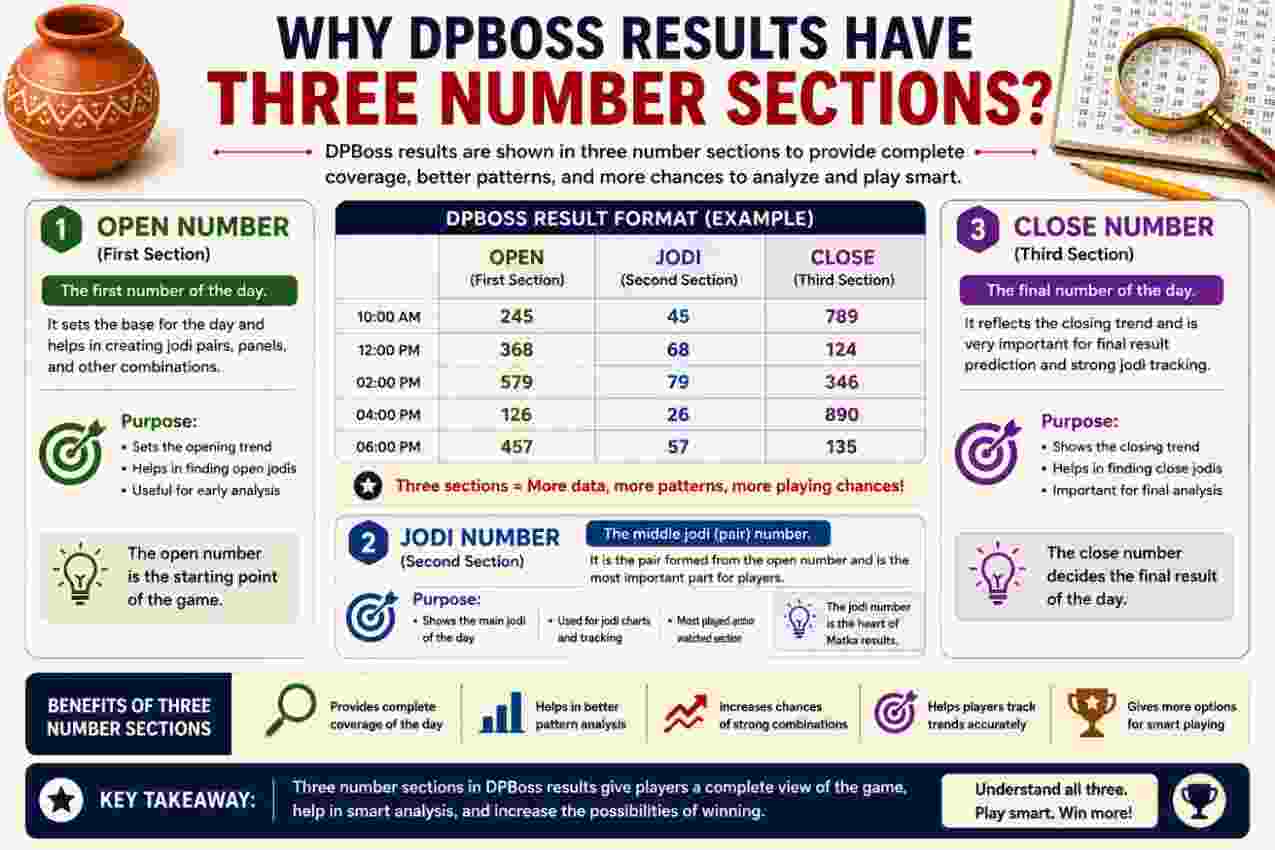
A Dpboss result often displays three connected number sections, such as 128-16-349. At first glance, this structure can look like a single long number. However, each section performs a separate function. The first three-digit panel creates the opening digit, the middle two-digit Jodi combines the opening and closing digits, and the final three-digit panel creates the closing digit. Reading these parts in the correct order helps readers verify calculations, recognise incomplete updates, and distinguish a full result from an isolated pair.
The Basic Three-Section Result Format
The standard result format contains an opening panel, a two-digit Jodi, and a closing panel. Together, these sections present the complete numerical record of one market session.
A result may appear as:
128-16-349
Each section communicates different information:
- 128: Opening panel
- 16: Complete Jodi
- 349: Closing panel
The first digit of the middle section comes from the opening panel. Similarly, the second digit comes from the closing panel. Consequently, all three sections connect through simple addition.
Why the Display Uses Hyphens
Hyphens separate the three sections and prevent readers from treating the result as one continuous eight-digit value. They also make the opening panel, Jodi, and closing panel easier to identify.
Without separators, 12816349 would provide little visual clarity. A reader could struggle to determine where one component ended and another began. Therefore, the formatted version, 128-16-349, communicates the structure immediately.
The Reading Order
Readers should examine a full result from left to right:
- Read the opening panel.
- Calculate its single digit.
- Match that digit with the first Jodi position.
- Read the closing panel.
- Calculate its single digit.
- Match that digit with the second Jodi position.
This order mirrors the normal declaration flow. Moreover, it provides a reliable method for checking whether every displayed component agrees mathematically.
The First Number Section: Opening Panel
The first section contains three digits and represents the opening panel. It supplies the first single digit used in the central Jodi.
For example, consider an opening panel of 128. Adding its digits produces the opening value:
- 1 + 2 + 8 = 11
- The last digit of 11 is 1
- Therefore, the opening digit is 1
This opening digit occupies the first position in the two-digit Jodi.
How the Opening Digit Is Calculated
The calculation follows a consistent process. Add all three panel digits, then retain the final digit of the total.
Consider several examples:
- 137 produces 1 + 3 + 7 = 11, so the digit is 1.
- 245 produces 2 + 4 + 5 = 11, so the digit is 1.
- 489 produces 4 + 8 + 9 = 21, so the digit is 1.
- 550 produces 5 + 5 + 0 = 10, so the digit is 0.
Although different panels can produce the same digit, each panel remains a separate three-number combination.
Why the Complete Panel Appears
Displaying only the opening digit would hide the calculation behind it. In contrast, the full panel allows readers to verify how the digit formed.
The panel also provides a more detailed record of the session. Two results may share the same opening digit while using completely different opening panels. Therefore, the first section preserves information that the central pair cannot show alone.
What an Opening-Only Result Looks Like
The opening panel often appears before the closing section. During that period, a display may show:
128-1
This format means that the opening stage has finished, but the closing declaration remains pending. Consequently, readers should not treat 1 as a complete Jodi.
Some layouts may show blank spaces, symbols, or placeholders after the opening section. Those indicators communicate an incomplete session rather than a zero-valued result.
The Middle Number Section: Jodi
The middle section contains two digits. It combines the opening digit with the closing digit and provides the shortest summary of the completed result.
In the example 128-16-349, the central pair is 16. The opening panel produces 1, while the closing panel produces 6. Therefore, the middle section joins those digits in declaration order.
How the Two Jodi Positions Work
The first Jodi position always relates to the opening panel. Meanwhile, the second position relates to the closing panel.
For the result 128-16-349:
- Opening panel 128 produces 1.
- Closing panel 349 produces 6.
- The two digits combine as 16.
Reversing the positions would create 61, which represents a different pair. Consequently, the sequence matters as much as the individual digits.
Why the Jodi Sits in the Centre
Placing the Jodi between both panels creates a logical visual connection. The left panel supplies its first digit, and the right panel supplies its second digit.
This design also supports quick scanning. Readers can see the summarized result immediately while retaining access to both supporting calculations.
Pairs That Begin With Zero
A central Jodi always contains two positions, even when the first digit equals zero. For example, if the opening panel produces 0 and the closing panel produces 7, the Jodi becomes 07.
Removing the opening zero would change the standard format and obscure the position of each digit. Therefore, accurate displays preserve pairs such as 01, 04, 07, and 09 as two-digit values.
Pairs With Matching Digits
When both panels produce the same digit, the central section contains a matching pair, such as 22, 55, or 88.
The identical digits do not mean that the panels must also match. For example, one panel may produce 5 through a total of 15, while the other produces 5 through a total of 25. Thus, the middle pair summarizes outcomes without revealing the exact panel combinations.
The Third Number Section: Closing Panel
The final three-digit section represents the closing panel. It supplies the second digit in the central Jodi and completes the result.
Using 349 as an example:
- 3 + 4 + 9 = 16
- The final digit of 16 is 6
- Therefore, the closing digit is 6
When combined with an opening digit of 1, the complete Jodi becomes 16.
Why the Closing Panel Appears Later
The opening and closing stages occur at separate times. As a result, the first panel may appear well before the third section becomes available.
This interval explains why some result rows look incomplete during an active session. Once the closing panel receives confirmation, the full three-section result can appear.
How the Closing Section Finalises the Record
Before the closing panel arrives, readers can verify only the opening calculation. Afterward, they can check both panel totals and confirm the central pair.
The third section changes the status from partial to complete. Additionally, it creates a full historical record that can be entered into a daily, monthly, or yearly chart.
Opening and Closing Panels Serve Different Roles
Both outer sections contain three digits and follow the same addition method. However, their positions distinguish their functions.
The left panel always controls the opening Jodi digit. In contrast, the right panel controls the closing Jodi digit. Treating the panels as interchangeable would reverse or distort the final pair.
How All Three Sections Connect
The three sections form one mathematical chain rather than three unrelated values. Each panel contributes one digit, and the centre section displays the combined result.
Consider the full format:
247-39-168
The connection works as follows:
- Add the opening panel: 2 + 4 + 7 = 13.
- Retain the final digit: 3.
- Place 3 in the first Jodi position.
- Add the closing panel: 1 + 6 + 8 = 15.
- Retain the final digit: 5.
- Place 5 in the second Jodi position.
- Confirm the complete Jodi: 35.
In this example, a middle display of 39 would not match the panels. Therefore, either the Jodi, closing panel, or copied value would require verification.
A Correct Calculation Example
Consider:
245-17-349
Opening calculation:
- 2 + 4 + 5 = 11
- Final digit = 1
Closing calculation:
- 3 + 4 + 9 = 16
- Final digit = 6
These panels actually produce 16, not 17. Consequently, the displayed pair would contain an inconsistency.
A correct version could appear as:
245-16-349
This example shows why the outer sections remain valuable. They allow readers to detect an incorrect central pair.
Another Complete Example
Consider:
137-10-550
Opening calculation:
- 1 + 3 + 7 = 11
- Opening digit = 1
Closing calculation:
- 5 + 5 + 0 = 10
- Closing digit = 0
The panels therefore create the Jodi 10. Every section agrees, making the result internally consistent.
Why One Number Section Would Not Be Enough
A single number could summarize part of the outcome, but it would remove important context. The three-section format preserves both source combinations and their resulting pair.
If a display showed only 16, readers could identify the Jodi but could not determine which panels produced it. Many different opening and closing combinations can generate the same two digits.
Multiple Panels Can Produce One Digit
Several panels may create an opening digit of 1:
- 128 totals 11.
- 137 totals 11.
- 245 totals 11.
- 489 totals 21.
Similarly, numerous panels can produce the same closing digit. Consequently, one Jodi may connect with many possible panel combinations.
The Full Format Supports Verification
The complete structure allows readers to confirm:
- Whether the opening panel produces the first Jodi digit
- Whether the closing panel produces the second Jodi digit
- Whether the pair uses the correct digit order
- Whether a copied result contains a reversal
- Whether a result remains incomplete
- Whether a correction affects one or more sections
Therefore, the three-part format functions as both a result display and an internal accuracy check.
The Format Preserves Historical Detail
Historical charts become more informative when they include both panels. A Jodi-only record supplies the central outcome, while a full entry preserves how each digit formed.
Moreover, detailed records help identify transcription mistakes. If a saved Jodi conflicts with its panels, readers can recheck the original entry instead of accepting the inconsistency.
Why Results Sometimes Show Fewer Than Three Sections
Not every visible result contains all three sections. An active session may display only the opening panel and digit because the closing stage has not finished.
A historical record may also show only the Jodi when its layout prioritizes compactness. Therefore, the number of visible sections can reflect timing or presentation rather than missing information.
Opening Stage Displays
An opening-stage entry might appear as:
128-1
This result confirms the opening panel and opening digit. However, it does not provide a closing digit or final Jodi.
Readers should wait for the remaining section rather than assuming a closing value.
Pending Closing Results
A pending display may use:
- Blank fields
- Dashes
- Asterisks
- “Pending” status
- Empty closing columns
Each indicator means the session has not reached its final form. Additionally, a delayed closing declaration may leave the partial result visible longer than expected.
Compact Historical Charts
Some archives list only two-digit Jodis to save space. A compact chart may still provide valid historical information, but it cannot support panel-level verification.
In contrast, a detailed Dpboss result preserves all three number sections and allows readers to check the arithmetic relationship.
Closed or Cancelled Sessions
A closed session may show a special symbol instead of numbers. Such a marker should never be treated as 00 or another valid pair.
Similarly, a cancelled session produces no complete three-section result. Personal records should preserve the closure marker to maintain accurate chronological order.
Common Reading Mistakes
The format remains straightforward once readers recognise the role of each section. Nevertheless, rapid scanning, unfamiliar layouts, and incomplete updates can cause avoidable errors.
A consistent reading method prevents most problems.
Reading All Digits as One Number
The result 128-16-349 represents three connected sections, not the number 12,816,349. Ignoring the separators removes the structure and meaning.
Therefore, readers should pause at each hyphen and identify the component before proceeding.
Confusing the Jodi With a Panel
The central Jodi contains two digits, while each panel contains three. A reader who mistakes 16 for a panel may attempt an invalid calculation.
The number of digits provides the quickest distinction:
- Three digits on the left: opening panel
- Two digits in the centre: Jodi
- Three digits on the right: closing panel
Reversing the Jodi
If the opening digit is 1 and the closing digit is 6, the Jodi becomes 16, not 61. The declaration order determines the pair.
Consequently, readers should calculate the left panel first and place its digit first.
Using the Full Total Instead of Its Final Digit
A panel total of 16 produces the single digit 6. It does not place 16 into one Jodi position.
Only the final digit of the panel sum matters for the open or close value. Therefore, totals such as 10, 20, and 30 all produce 0.
Dropping a Leading Zero
A pair such as 04 must retain both digits. Writing it as 4 hides the opening position and makes the result look like a single digit.
Similarly, panels containing zero must preserve all three positions when the standard format requires them.
Treating a Partial Result as Final
An opening panel and digit do not form a completed result. The closing panel must appear before the central Jodi can receive its second digit.
Readers should check the session status before copying or recording the entry.
How to Verify a Three-Section Result
Verification requires only basic addition and careful attention to position. A short routine can identify most copied or formatting errors.
Use the following process:
- Confirm the date and market row.
- Separate the opening panel, Jodi, and closing panel.
- Add the three opening digits.
- Retain the final digit of that total.
- Compare it with the first Jodi digit.
- Add the three closing digits.
- Retain the final digit of that total.
- Compare it with the second Jodi digit.
- Recheck any mismatch before saving the result.
Checking the Date and Row
A mathematically correct result can still belong to the wrong date or session. Consequently, readers should verify contextual details before checking arithmetic.
Dense layouts may place several results close together. Tracing one row from left to right helps prevent accidental mixing between neighbouring entries.
Handling a Mismatch
A mismatch may result from:
- A mistyped panel
- A reversed Jodi
- An incomplete update
- A copied digit from another row
- A display refresh issue
- A later correction
- A lost leading zero
Readers should not automatically change one section to make the calculation fit. Instead, they should wait for a stable, confirmed entry.
Recording the Full Result
A clear personal record can use this structure:
Date | Opening Panel | Jodi | Closing Panel | Status
The status field can identify completed, delayed, corrected, closed, or unavailable sessions. Moreover, consistent formatting makes future verification easier.
Why Corrections May Affect Several Sections
A correction to one panel can change its derived digit and, consequently, the central Jodi. Therefore, readers should recheck the entire result after any update.
Suppose the closing panel changes from 348 to 349:
- 3 + 4 + 8 = 15, producing 5.
- 3 + 4 + 9 = 16, producing 6.
If the opening digit remains 1, the Jodi changes from 15 to 16. One corrected panel digit therefore affects two visible parts of the result.
Panel-Only Corrections
Sometimes a panel changes while producing the same final digit. For example:
- 128 totals 11 and produces 1.
- 137 totals 11 and also produces 1.
In that situation, the Jodi can remain unchanged even though the outer section changes. Consequently, checking only the middle pair would miss the correction.
Jodi-Only Display Errors
A central pair may contain a typographical mistake even when both panels appear correctly. Calculating each panel exposes that issue immediately.
For instance, panels producing 2 and 8 must create 28. A displayed Jodi of 82 reverses the required order.
Why Complete Rechecking Matters
After a correction, verify:
- The updated panel
- Its digit total
- The related Jodi position
- The full pair order
- The session date
- The final status
This process prevents an earlier version from remaining in personal records.
What the Three Sections Cannot Show
The three-part format provides a clear result record, but it cannot guarantee future outcomes. It reports completed numerical information rather than a dependable prediction.
Historical panels and Jodis may repeat, reverse, or form noticeable sequences. However, those patterns describe past declarations only.
Past Results Do Not Control Future Results
A panel that appeared several times does not become certain to return. Similarly, a long absence does not make a particular Jodi overdue.
The three sections support calculation and verification, not guaranteed forecasting.
Visible Patterns Can Mislead
Readers may notice repeated digits, mirrored panels, consecutive pairs, or familiar totals. Nevertheless, random sequences can contain attractive patterns without following a stable rule.
Therefore, every pattern claim should remain separate from the factual result structure.
Responsible Financial Behaviour Matters
Number-based gambling carries financial risk. Anyone who chooses to participate should set strict limits and keep household funds, savings, emergency money, and borrowed funds separate.
Moreover, chasing losses can increase financial harm. No panel calculation or historical sequence removes uncertainty.
Local Laws Still Apply
Rules concerning gambling vary across jurisdictions. Access to Dpboss result information does not automatically make related participation lawful.
Consequently, readers should check applicable regulations and avoid any activity prohibited in their location.
Conclusion
A Dpboss result contains three number sections because each part records a different stage of the completed outcome. The opening panel produces the first Jodi digit, the central pair combines both single digits, and the closing panel produces the second digit. This format preserves detail, supports arithmetic verification, and distinguishes partial updates from final results. By reading from left to right, retaining leading zeroes, checking panel totals, and rechecking corrections, readers can interpret the structure accurately without confusing historical information with a guarantee of future outcomes.
FAQs
What are the three sections in a Dpboss result?
The first three-digit section represents the opening panel, the middle two-digit section represents the Jodi, and the final three-digit section represents the closing panel. Each outer panel produces one single digit through addition. Those two digits then combine in opening-to-closing order to create the central pair.
How does a three-digit panel create one digit?
Add all three digits in the panel and retain the final digit of the total. For example, 349 totals 16, so it produces 6. Similarly, 550 totals 10 and produces 0. That single value occupies either the opening or closing position within the two-digit Jodi.
Why does a result sometimes show only two sections?
The session may still await its closing declaration. In that case, the display can show the opening panel and opening digit without a completed Jodi or closing panel. Alternatively, a compact historical layout may display only selected information. Readers should check the status before treating any partial entry as final.
Can different panels produce the same Jodi digit?
Yes. Many three-digit panels can produce the same final digit because their totals may end identically. For example, panels totaling 11, 21, or 31 all produce 1. Consequently, the Jodi alone cannot reveal the exact opening and closing panels connected with a completed result.
What should readers do if the panels and Jodi do not match?
Recalculate both panels, confirm the digit order, and check for transcription mistakes, pending updates, or corrections. Readers should also verify the date and market row because neighbouring entries may appear close together. A result should enter a permanent record only after all three sections agree and show final status.