
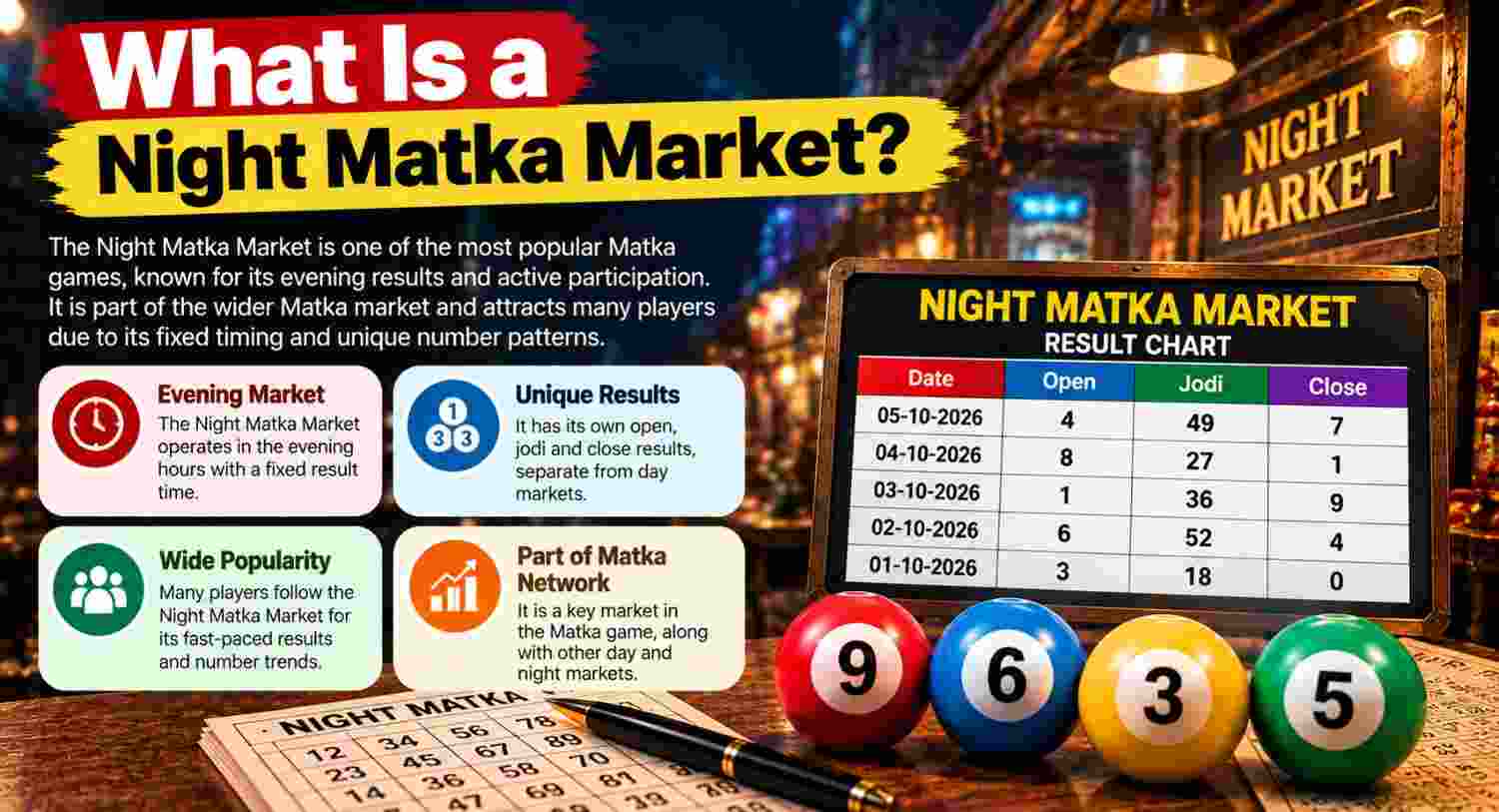
A night matka market generally refers to a separately identified betting market or result session associated with later operating hours. Within satta matka, the word “night” usually describes timing or market identity rather than a completely different form of gambling. Different markets developed separate names, schedules and result streams, so several night-labelled markets may exist without belonging to one unified operation. Their identities can reflect historical practice, local recognition or scheduling conventions. Because those arrangements can change, a night-market label should be read as a broad classification rather than proof of one fixed timetable or identical set of rules.
What “Night Market” Actually Means?
Within this setting, a “market” can identify a recognised betting session, an independently known operation or a particular stream of results.
A night-market label usually indicates that the relevant operation historically ran, or became associated, with later hours. However, the label alone does not reveal everything about that market. A name may also reflect local usage, an older operating identity or a long-established result sequence.
Why Timing Becomes Part of Market Identity
Timing became important because separate markets needed practical ways to distinguish their sessions.
Several timing-related features could contribute to that identity:
- when a market traditionally accepted entries;
- when its first declared result appeared;
- when a later result followed.
Historically, timing labels also made result reporting easier to organise across separate sessions. A later-hour identity could distinguish one recognised stream from another without changing the broad number-based concept. However, that practical distinction should not be mistaken for a universal classification system, because informal markets developed through different local practices and operating arrangements entirely.
Repeated association between a name and a particular operating window could make timing part of the market’s identity. Nevertheless, schedules are not permanent historical facts, and an older description should not automatically be treated as a current timetable.
How Opening and Closing Sessions Fit the Structure
Traditional matka terminology commonly distinguishes between an opening stage and a closing stage. Historically, the broader activity developed from wagering linked with opening and closing cotton-rate figures transmitted to Bombay. Later number-based systems retained open-and-close language after the original commodity-rate connection disappeared.
In a night market, those terms generally refer to separate result points within the same recognised session. However, the terminology should remain descriptive. It does not imply a prediction method, and past results do not establish later outcomes.
How Night Markets Differ From Other Market Types
A night market does not automatically use a fundamentally different number system from markets associated with earlier hours. The main distinction may lie in identity, operating period, historical background or result stream.
Broad differences can include:
- earlier versus later operating periods;
- separate market names and identities;
- independently reported result streams;
- different historical associations.
Therefore, two markets can share similar terminology while remaining separate operations.
Why Night Markets Can Have Separate Names
Multiple night markets appeared because the broader system developed through decentralised operations rather than one central authority. Different organisers could establish their own schedules, labels and result streams.
Separate names may reflect:
- independent historical operations;
- different scheduling windows;
- regional or neighbourhood associations;
- inherited names that remained familiar;
- later variants using related naming patterns.
The exact origin of a particular name is not always well documented. Informal networks rarely produced consistent public records, and later retellings can conflict.
How Timing-Based Market Identities Developed
The broader matka system developed from an earlier form of wagering connected with cotton-price information in Bombay. When that external source ceased to support the betting practice, locally generated number systems expanded. Separate markets then emerged with their own identities and operating periods.
As those operations multiplied, timing offered a way to distinguish sessions. Some became associated with earlier periods, while others acquired identities linked with evening or later-hour operation. Gradually, a recognised market name could signify schedule, historical lineage, result stream and local familiarity.
What Digital Result Listings Changed
Older market identities once circulated mainly through physical collection points, local networks, telephone communication and manually shared results. Digital publication later placed many names side by side, making the variety more visible.
Some names pre-date digital publication, while others may be later derivatives or adaptations. Online listings can preserve older terminology, reproduce modified names and group unrelated operations under similar labels. Consequently, digital visibility expanded awareness without necessarily standardising the naming system.
Why Night Market Timings Can Change
Night-market timings can change because operating arrangements are not fixed by a central authority. Organisers may alter sessions, discontinue markets, rename operations or change communication methods.
For that reason, historical schedule information needs context. A timing associated with a market in one period may not remain valid later.
Why Similar Formats Do Not Mean the Same Market
Several markets may use similar open-and-close terminology, number conventions or result structures. That shared vocabulary does not make them the same market.
A separate identity may depend on:
- its recognised name;
- its result stream;
- its operating schedule;
- its local or historical association.
Likewise, the word “night” describes only part of the identity. It may signal a later operating period, but the complete history of a market can involve other factors. Assuming that all night markets follow identical rules or schedules oversimplifies a fragmented system.
Legal and Social Context in India
Gambling regulation in India depends on jurisdiction, the nature of the activity and the legislation applicable in a particular state or Union territory. The Public Gambling Act of 1867 forms part of the historical legal framework in some jurisdictions, while states may apply their own laws or amendments.
Number-based wagering associated with satta matka has generally existed outside formally authorised gambling structures. However, legal treatment should not be reduced to one nationwide statement because state-level rules and enforcement can differ. A night-market label does not create any special legal status. Historical recognition or online visibility also does not establish that an operation is permitted.
Conclusion
A night matka market is best described as a separately recognised market or result session associated with later operating hours within the broader number-based betting system. Timing helps shape its identity, but names can also reflect history, locality, organisers and established result streams. Open and close terminology may appear across several markets, yet similar vocabulary does not make those markets identical. Moreover, schedules and names can change as operations evolve. The classification therefore explains when and how a market became recognised, not a universal set of rules shared by every night-labelled operation.