
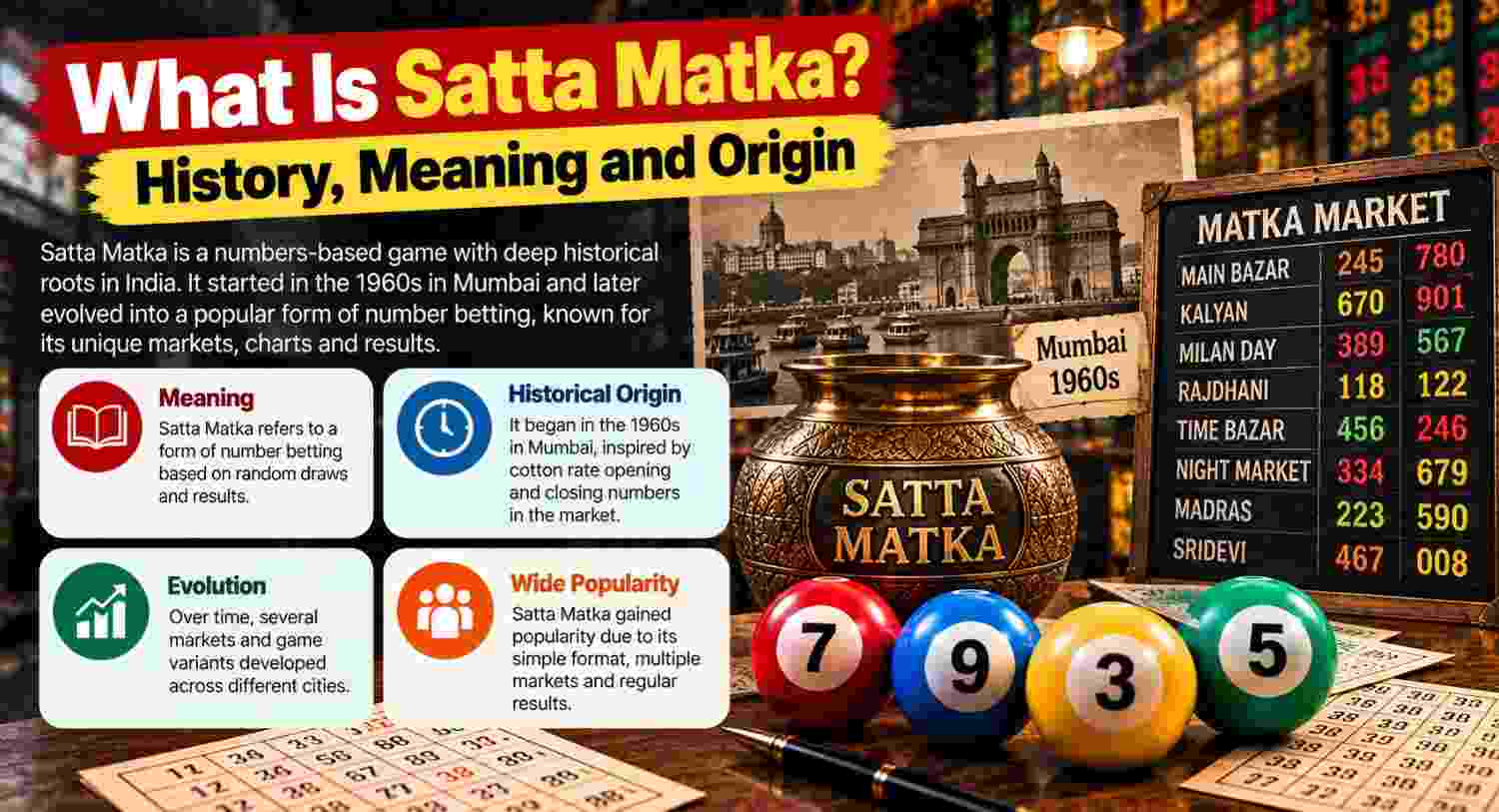
Satta matka refers to number-based gambling that developed in Bombay, now Mumbai, from an earlier betting practice linked with cotton prices. The activity did not begin as the familiar number-draw format later associated with the name. Instead, early wagers reportedly focused on figures connected with cotton-market quotations. As the original source of those figures disappeared, organisers adapted the activity into locally generated number results. Over time, the system acquired its own terminology, named markets and result structures while retaining words that reflected its earlier form.
At its basic level, the activity involved staking money on numerical outcomes announced through an organised market. Historically, related words referred both to wagering and to declared results. Consequently, terms such as open, close and market could describe parts of the result system rather than separate gambling activities. That distinction explains why historical accounts often discuss result reporting alongside betting practices.
Origins in Cotton-Rate Speculation
Accounts of the activity commonly trace its roots to Bombay during the 1950s, when participants reportedly wagered on the opening and closing cotton rates transmitted from the New York Cotton Exchange to the Bombay Cotton Exchange. Teleprinters carried commodity information across markets, and the final digits of those quotations became the focus of speculative bets.
The early arrangement therefore depended on an external commercial figure rather than a locally produced draw. Two moments carried particular significance:
- the opening cotton quotation supplied one reference point;
- the closing quotation supplied another;
- wagers centred on numerical endings rather than physical cotton ownership;
- result language reflected the timing of those market quotations.
In 1961, according to widely repeated historical accounts, the transmission practice that supported this betting format ended. Consequently, the existing wagering network lost the external figures on which it had relied. Organisers then shifted towards methods that produced numbers locally. This transition marked the decisive break between cotton-rate speculation and the later number-based form.
How Mumbai Shaped the Later System
Mumbai became closely associated with the activity because its cotton trade, textile economy and working-class districts created the setting where both formats circulated. As the cotton-based model declined, organised number markets appeared under distinct names and schedules.
Historical reporting links particular operators and named markets with this period, but sources differ on dates and details. Therefore, cautious accounts focus on the broader pattern: local organisers replaced external cotton quotations with internally generated numbers, and separate markets gradually developed their own routines.
Why the Name “Matka” Endured
The word “matka” means an earthen pot or pitcher. In one widely reported early method, organisers placed numbered slips inside such a container and drew a slip to determine a result. The physical pot therefore became closely identified with the number-draw system.
Later methods changed, and some versions reportedly used playing cards or other procedures instead of an actual earthen pot. Nevertheless, the old name survived. That continuity explains why modern uses of the term may refer to systems without a physical matka.
From Simple Draws to Named Markets
As the system developed, result formats became more elaborate. Historical terminology came to include single numbers, combinations, opening results and closing results. These expressions reflected how organisers structured and reported outcomes, although exact rules could vary between markets.
Several features helped distinguish later forms from the cotton-rate stage:
- organisers generated results locally rather than relying on overseas commodity quotations;
- named markets followed their own schedules;
- open and close declarations became part of the result structure;
- combinations and multi-number formats appeared in different variants.
Because separate markets evolved independently, readers should not assume that every version followed identical rules. Names, timings and result conventions could differ, even when participants used the same broad label.
Historical Form and Modern Usage
The meaning attached to the name expanded as communication methods changed. Earlier activity depended on physical locations, local collectors and manually announced results. Later, telephones, printed charts and other communication channels helped circulate numbers more widely. Digital platforms subsequently made result information easier to distribute, but they did not preserve every feature of the older system.
As a result, modern references may describe several loosely related number-gambling formats rather than one historical practice. The connection lies mainly in inherited terminology, market names and the open-close tradition. Therefore, separating the cotton-linked origin from later adaptations prevents historical simplification.
Why Historical Accounts Sometimes Differ
Sources often repeat the same broad sequence while disagreeing about founders, precise starting dates, individual market launches or procedural details. Much of the activity operated informally, which limited consistent record-keeping. Later retellings also mixed local memory, press reporting and gambling-related sources.
For that reason, firm claims require caution. The strongest recurring historical points are the connection with cotton-rate betting in Bombay, the shift after that system ended, the use of a matka in early number selection, and the later growth of named number markets. More specific claims deserve qualification when reliable records conflict.
Legal and Social Context in India
Gambling regulation in India does not apply uniformly across every jurisdiction. The Public Gambling Act of 1867 remains part of the historical legal framework in certain areas, while states and Union territories may apply their own gambling laws, amendments or restrictions. Consequently, legal status can depend on location, activity type and the legislation in force.
Satta matka has been associated with unregulated wagering rather than authorised gaming. However, broad statements that every gambling activity has identical legal status across India can mislead. Anyone researching its present status should distinguish historical description from current legal rules and consult local law.
Conclusion
Satta matka developed through a historical transition. Its roots lay in betting on cotton-market figures transmitted to Bombay, but the end of that arrangement pushed organisers towards locally generated number results. The use of an earthen pot helped give the activity its enduring name, while open-close terminology and named markets carried elements of the earlier system forward. Later offline and digital versions changed the mechanics substantially. Its history therefore reflects adaptation from commodity-linked speculation into varied number-based gambling formats rather than one fixed system.