
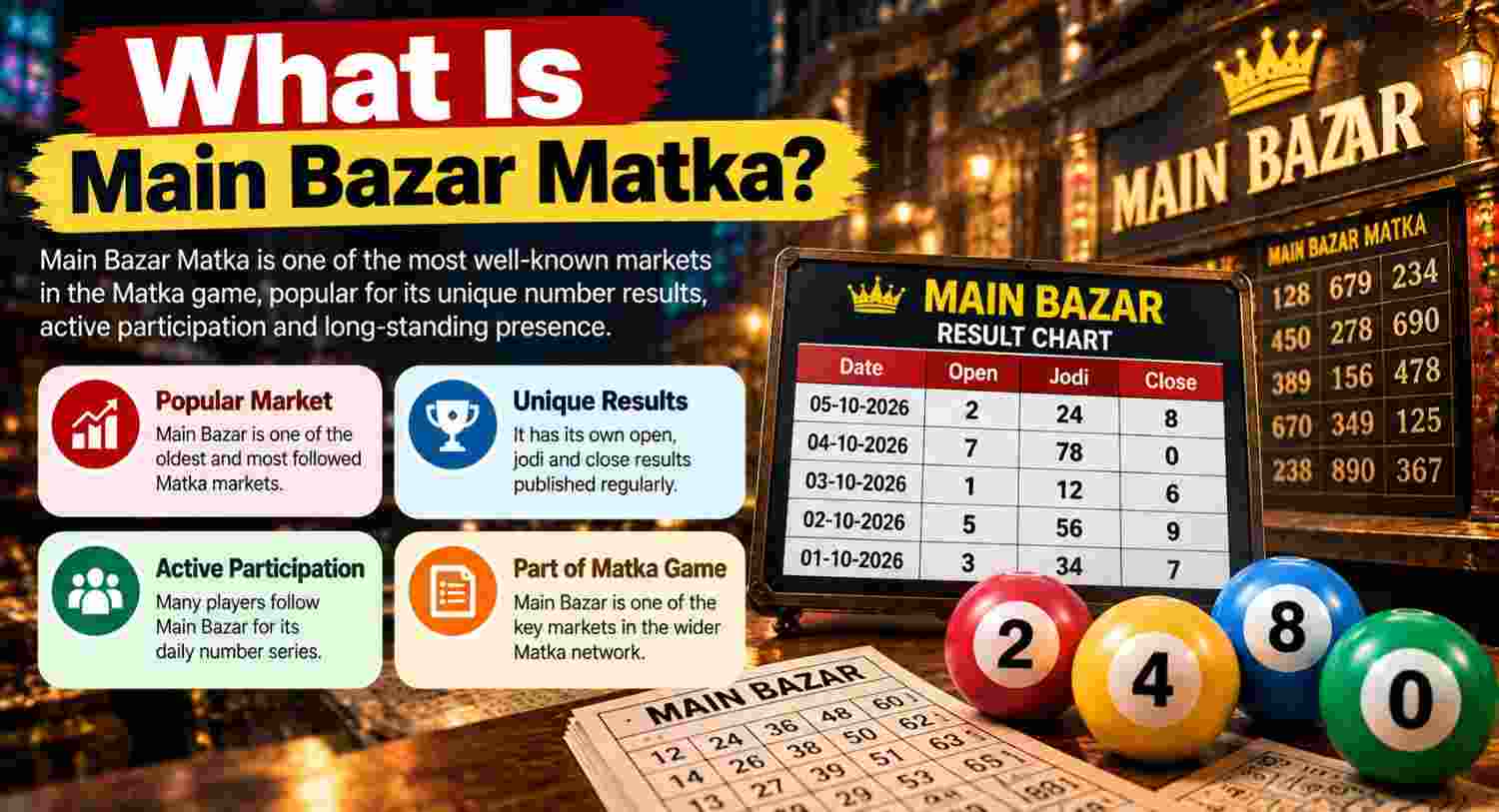
Main Bazar Matka refers to a separately recognised market identity within the broader satta matka system. It is not another name for the entire activity. Instead, Main Bazar functions as one named result stream with historical recognition, operating conventions, and market terminology. Its identity developed within a wider network of number-based markets that emerged after earlier cotton-rate betting in Bombay changed into locally organised number systems. Because records about individual markets are often incomplete, precise claims about its first operator, founding date or original location require caution.
What Main Bazar Actually Refers To?
Within matka terminology, a “market” generally means a recognised operation, session or result stream rather than a physical bazaar. A named market can therefore possess a separate identity when it shares conventions with other markets.
Main Bazar is recognised in this narrower sense. Its name identifies a particular stream within the wider betting framework. Several characteristics can distinguish such a market:
- a recognised market name;
- its own result sequence;
- an operating period associated with that identity;
- established local or historical recognition;
- terminology carried forward through repeated use.
Consequently, the market name and the broader activity should not be treated as interchangeable expressions.
How Main Bazar Fits Within Satta Matka
Satta matka refers to the wider number-based betting framework developed from an earlier practice linked with cotton-price quotations in Bombay. Historical accounts commonly trace that earlier form to wagers on opening and closing cotton rates transmitted from the New York Cotton Exchange to the Bombay Cotton Exchange during the 1950s. When that system ceased to provide the same basis for wagering, locally generated number systems expanded.
Named markets later became one way to organise separate result streams. Main Bazar belongs to that broader pattern. Therefore, its identity makes sense only when separated from the history of the overall system.
Why Main Bazar Developed a Separate Identity
Individual market names gained recognition through repeated use. Different organisers, schedules, local networks and result sessions could produce separate identities even where broad number conventions looked similar.
For Main Bazar, the name itself became an identifier. However, reliable public material does not consistently establish one account explaining who first used the name, exactly when it appeared, or why those particular words were chosen. A historical description should therefore avoid inventing a founder or literal naming story.
Recognition can persist for several reasons:
- repeated reference to the result stream;
- association with a particular result stream;
- continuity across changing communication methods;
- longstanding use within informal networks;
- later reproduction in digital listings.
What Opening and Closing Mean in Market Terminology
Historically, the wider matka system used “open” and “close” terminology for different result stages. Those words have roots in the earlier cotton-rate form, where opening and closing quotations carried significance. Later number-based markets retained similar language even after the commodity connection had faded.
Within a named market such as Main Bazar, open and close generally describe separate stages of a result sequence. They do not represent different markets by themselves. Moreover, the terminology does not provide a method for forecasting later outcomes.
Why Timing Helps Distinguish Named Markets
Operating periods also help distinguish one named market from another. Separate result windows can make two otherwise similar markets recognisable as different streams.
However, schedules should not be treated as permanent historical facts. Informal operations can change their routines, suspend activity, adopt revised timings, or disappear entirely. As a result, an older reference to a Main Bazar schedule does not establish a current operating period.
How Main Bazar Differs From Other Named Markets
Main Bazar exists within a larger collection of separately recognised markets. Some may use broadly similar terms, result streams, or number-based conventions. Nevertheless, shared structure does not make them identical.
Differences may involve:
- market identity;
- operating period;
- historical background;
- result stream;
- local recognition;
- naming tradition.
Therefore, a familiar label identifies a specific market tradition rather than a universal version of matka.
From Offline Recognition to Digital Visibility
Before widespread digital publication, named markets depended heavily on informal networks and repeated circulation of their established identities. Names could survive because people referred to the same result stream consistently over time.
Later, internet-based result pages and messaging channels made numerous market names visible in one place. That shift increased the apparent prominence of Main Bazar and similar labels, but digital publication does not prove that the internet created those markets. Online listings often reproduced identities that already existed offline.
Why Information About Main Bazar Can Conflict
Readers may encounter conflicting descriptions of Main Bazar because informal gambling markets rarely maintain transparent historical records. Differences can appear in claims about schedules, operating status, result formats, or origins.
Several factors can create disagreement:
- older information remaining online;
- changed operating routines;
- unofficial reproductions;
- derivative or similar names;
- confusion between historical and current descriptions.
Consequently, a single online listing should not be treated as definitive evidence of a market’s history or present status.
Common Misconceptions About Main Bazar
Several misconceptions can distort the subject. Main Bazar is not simply another name for every satta matka market. A recognisable name does not prove that a market follows the same rules as another one, and digital visibility does not establish legality, reliabilit,y or continuity. Historical results also do not demonstrate that future numerical outcomes can be predicted. Similarly, an old schedule may no longer reflect current practice.
Legal and Social Context in India
Gambling regulation in India depends on jurisdiction, the nature of the activity, and the legislation applicable in a state or Union territory. The Public Gambling Act of 1867 remains part of the historical legal framework in some jurisdictions, while states have their own laws and restrictions.
Main Bazar’s historical recognition does not give it a special legal status. Likewise, appearing in online result listings does not establish that participation is lawful. Any legal assessment requires attention to the rules applicable in the relevant jurisdiction.
Conclusion
Main Bazar Matka is best described as a distinct named market within the broader satta matka framework. Its separate identity comes from repeated naming, result-stream recognition, operating conventions, and historical continuity rather than from being a completely different gambling system. Open and close terminology, timing differences, and digital listings help explain how that identity appears, but they do not establish one permanent structure. Because records about individual markets can conflict, cautious historical wording remains necessary. Its familiar name reflects a market tradition, not proof of legality, predictability, or uniform operation.