
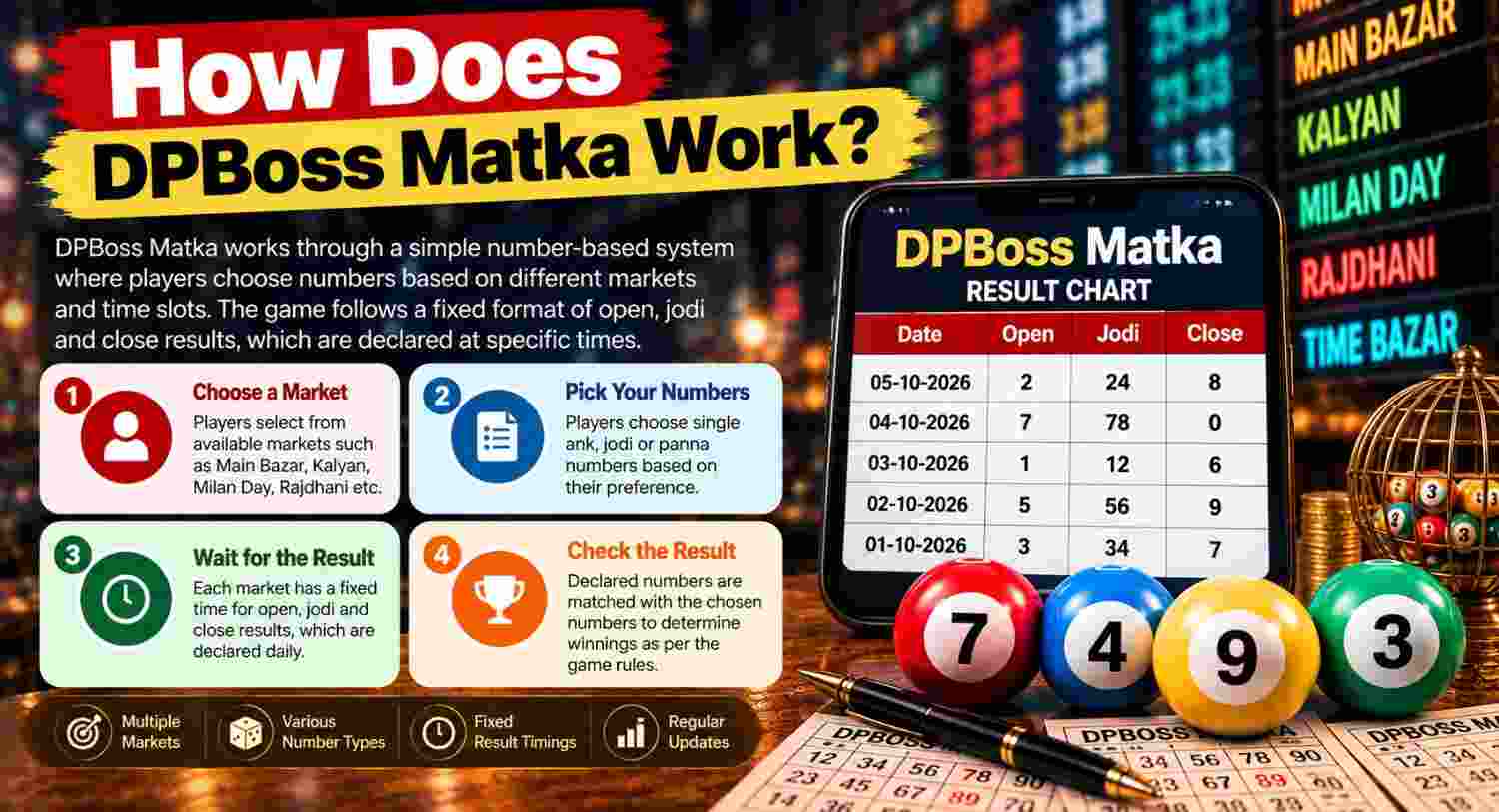
DPBoss Matka generally refers to online pages or search results that organise information connected with Matka-style gambling. Readers may encounter market names, schedules, open and close labels, published results, historical records, and related terminology. From a reader’s perspective, the system mainly presents information in a sequence: a market appears, a schedule indicates expected timing, status information changes, results appear, and older entries move into historical records. Viewing these pages differs from placing a wager. Participation introduces separate financial, legal, privacy, and behavioural risks, so information displays should never be treated as proof of legitimacy or guaranteed outcomes.
What Does DPBoss Matka Generally Mean?
DPBoss Matka functions primarily as a search label associated with Matka-related information pages. Such pages can collect result-oriented material into a single layout so readers can see names, timings, status messages, recently published outcomes, and older records.
Therefore, readers should separate the appearance of organisation from evidence of reliability.
Matka itself refers to number-based gambling. Online pages surrounding it may serve several different purposes. Some primarily display reported results, while others may mix informational content with advertising, prediction claims, contact prompts, or payment requests.
A reader can examine terminology or past results without participating in gambling. Once someone stakes money or transfers value on an uncertain outcome, however, the interaction moves beyond simple information viewing and creates additional risks.
How the Information Flow Usually Works
From a reader’s viewpoint, Matka-related pages often follow a recognisable information flow.
A typical page may present:
- a market or category name;
- a published or expected schedule;
- a current status label;
- opening-related information;
- closing-related information;
- a reported result;
- an archive containing older entries.
The market name acts as an identifier. The schedule indicates when a source expects information to change or appear. Status labels may show that a stage has not started, has opened, has closed, or has received an update.
After a source publishes a result, the page may move that entry into a chart or historical section.
However, this sequence should not be mistaken for an official verification process. Consequently, two sources can show different information at the same moment.
Market Names and Schedules
Matka-related pages often group information around separate market names. A market name identifies a particular result category or session within the page’s structure.
Schedules usually indicate when a source expects particular information to appear.
Nevertheless, displayed schedules may change. A source can publish an old timetable, experience a delay, copy a schedule from another page, or fail to update cached content. For that reason, a listed time should not automatically be treated as independently verified.
Search results can also surface archived pages that still display old timings.
Readers should therefore treat schedules as source-provided information. They describe how a page organises expected updates, not a guarantee that a particular result will appear precisely at the stated time.
What Open and Close Information Means
Open and close labels describe different stages within the way Matka-related results are presented.
An opening label generally marks earlier result-related information, while a closing label marks a later stage. Some pages place both within one row so readers can distinguish the stages without opening separate records.
The exact formatting may vary. Consequently, unfamiliar layouts can look different even when they describe similar stages.
Explaining calculations, number derivations, combinations, or ways to use one stage to predict another would turn a neutral explanation into gambling instruction.
Most importantly, an opening result does not create reliable certainty about a later outcome. Historical relationships can look meaningful after the fact, but they do not guarantee future gambling results.
How Result Publication Appears on Pages
Result pages may update information manually, automatically, or through an undisclosed publishing process.
Before publication, a row may display a waiting or pending status. Later, numbers or result fields may appear.
Delays can occur between the claimed event time and the time a page changes. Cached versions in browsers or search engines can continue displaying older information even after the source changes.
Because update frequency varies, simultaneous checking across several pages may produce conflicting results. One source may update first, while another may copy later or retain an error.
Frequent refreshing does not establish official status. Likewise, fast publication does not prove that a result is correct. Readers should treat visible updates as claims published by that source unless independent authority or verification clearly exists.
Historical Results and Charts
However, a record of past outcomes does not become a forecasting tool merely because a page displays it in a grid or sequence.
Past results and predictions serve different purposes. Combining the two can encourage false confidence, especially when someone assumes that repeated patterns must continue.
No archive can guarantee future gambling outcomes. Apparent streaks, repetitions, gaps, or visual patterns may attract attention, but they do not establish certainty.
Readers should also remember that historical records inherit the weaknesses of the source that created them. If a page copied an incorrect result, entered the wrong date, or failed to correct an error, the archive may preserve that problem.
Common Terminology Readers May Encounter
Common labels include:
- Market: a named result category or session.
- Schedule: the timing information associated with a market or update.
- Open: an earlier stage of result-related information.
- Close: a later stage of result-related information.
- Result: an outcome reported by the page.
- Chart: an organised display of older reported outcomes.
- History: archived information from previous dates or sessions.
- Update: a change to status, timing, or result information.
- Panel-related wording: specialised gambling terminology that some pages use around result displays.
Panel-related terms can become operational quickly, so a high-level definition provides enough context for informational reading. Readers do not need calculations, combinations, or prediction methods to recognise that such wording belongs to the broader gambling vocabulary.
Why Different Websites Can Show Different Information
A page may update several minutes later than another source. Meanwhile, a copied page may repeat an error because it relies on secondary information rather than its own verification process.
Other causes can include:
- outdated cached versions;
- incorrect timestamps;
- delayed publication;
- duplicated websites;
- copied schedules;
- incomplete corrections;
- impersonation pages;
- misleading status messages.
Prominent search placement does not settle such conflicts.
If two pages disagree, readers should avoid assuming that the first result they see must be correct. Similarly, repeated information across several domains may still trace back to one original source. Repetition can multiply an error instead of confirming a fact.
Information Viewing and Gambling Are Different Activities
In contrast, gambling involves staking money or something of value on an uncertain outcome.
That shift can introduce several additional concerns:
- possible financial loss;
- legal restrictions;
- exposure of payment information;
- collection of personal details;
- behavioural risk from repeated wagering;
- contact with unverified intermediaries.
A result page also does not prove that a gambling service connected with it has authorisation.
Therefore, readers should evaluate any request for money or personal data independently from the result information displayed nearby. A page can appear accurate in one area while still presenting unsafe financial requests, questionable promotions, or misleading claims elsewhere.
Online Credibility and Safety Checks
Gambling-related searches can expose readers to cloned pages, impersonation attempts, suspicious downloads, false guarantees, and aggressive requests for payment.
Warning signs include:
- claims of guaranteed future results;
- demands for immediate advance payment;
- requests for passwords or one-time authentication codes;
- requests for banking credentials;
- unfamiliar payment links;
- downloadable files from unknown sources;
- copied branding with slightly altered web addresses;
- unsolicited messages offering fixed outcomes;
- pressure to act before a supposed deadline;
- unrealistic profit promises.
A claim that someone has certain advance knowledge of a gambling outcome should not gain credibility merely because it appears beside genuine-looking historical data.
Malicious downloads can create risks involving device security, account access, or data theft.
Privacy and Personal Data Risks
Sensitive data can include phone numbers, identification documents, bank details, card information, account passwords, one-time authentication codes, and private login credentials. Unnecessary requests for such information deserve caution.
An unknown app may request access to contacts, messages, storage, location, or other device functions that have little connection with displaying public result information.
A page that displays results can be read without assuming that every linked service, download, or contact channel deserves trust.
Impersonators may also move conversations to private messaging services and use urgency to pressure a person into sending data or money. That change from public information to private financial communication creates a separate security concern.
Financial and Behavioural Risks
Gambling involves uncertain outcomes and can cause financial loss.
A particularly harmful pattern can develop when someone tries to recover previous losses by continuing to gamble or increasing financial exposure. Losses do not make a future win more likely, and repeated participation does not create a guaranteed recovery path.
Behavioural warning signs can include:
- spending more than planned;
- borrowing money for gambling;
- repeatedly returning after losses;
- hiding gambling-related spending;
- neglecting work or personal responsibilities;
- feeling unable to stop despite negative consequences.
Anyone facing serious difficulty can consider stepping away from gambling-related environments and seeking appropriate professional or community support. Reducing exposure to repeated promotional messages, result notifications, or gambling groups may also help create distance from triggering material.
Legal Context in India
India now has a central legal framework addressing online money games, alongside other laws and state-level rules that may remain relevant to gambling activity.
Online money gaming receives specific national regulation, while physical gambling and related conduct may also involve state or Union Territory legislation. Courts, enforcement practices, and later legal changes can affect how rules apply in individual circumstances.
If someone considers participating in any gambling-related activity, checking the current rules for the relevant jurisdiction matters because legal treatment can differ according to format and facts.
Common Misconceptions About How the System Works
Past results reveal future outcomes
Historical entries document what a source says happened earlier. They do not create a dependable method for identifying what will happen next. Visual patterns can appear convincing without carrying predictive certainty.
Frequent updates prove official status
A page can refresh often without having government approval, regulatory recognition, or independent verification. Update speed describes publishing behaviour, not authority.
Guaranteed predictions remove uncertainty
No paid claim, private message, or supposed fixed number converts an uncertain gambling event into a guaranteed return. Such promises deserve particular caution.
Every result page works identically
Layouts, update timings, source methods, terminology, and historical records can differ. Similar appearance does not prove common ownership or data quality.
Search ranking proves legitimacy
Search position does not establish legal status or factual accuracy. A highly visible page can still contain outdated, copied, or misleading information.
How Page Changes Can Create Confusion
Another practical distinction concerns the difference between a page update and a verified event. A page can change its displayed status because an editor entered new information, an automated feed refreshed, or cached content expired. None of those actions proves that the underlying information received independent confirmation. Consequently, readers should treat page behaviour as evidence of publication activity rather than evidence of accuracy.
Timing can also create confusion. A source may show one status while another still displays an earlier stage, especially if updates occur at different intervals. Browser caching can preserve an older version even after the publisher changes the page. Refreshing may reveal newer material, but it still does not establish authority.
Corrections deserve similar caution. If a source replaces an earlier entry, readers may see different versions across screenshots, cached pages, or copied websites. That does not automatically mean deliberate deception; ordinary publishing errors can also occur. However, unexplained changes reduce confidence in historical records. For neutral information checking, readers should distinguish visible publication changes from claims that an outcome has been officially confirmed elsewhere online.
Practical Takeaways for Readers
DPBoss Matka-related pages generally work by organising market labels, schedules, status information, reported results, and historical records into a readable sequence.
For neutral information checking, readers can focus on a few distinctions:
- reported results are not predictions;
- historical charts do not guarantee future outcomes;
- schedules can become outdated;
- copied pages can repeat errors;
- search visibility does not prove authority;
- public viewing differs from wagering;
- payment or data requests introduce new risks.
A timestamp, table, or archived record may look precise, while nearby advertising may promise certainty that the underlying information cannot support.
Where legal status matters, current rules for the relevant jurisdiction should take priority over claims made by gambling-related pages or private messages.
Conclusion
DPBoss Matka-related information usually follows a simple display pattern: market names connect with schedules, status information changes, results appear, and older entries move into historical records. However, the organised appearance of a page does not prove accuracy, legal authorisation, or future certainty. Readers should separate informational viewing from gambling participation, question guaranteed-result claims, protect personal and financial data, and recognise the possibility of financial or behavioural harm. Where participation is contemplated, current legal rules for the relevant jurisdiction require separate checking.
FAQs
What does DPBoss Matka generally display?
It generally refers to Matka-related pages that may display market labels, schedules, opening and closing status, reported results, and historical records. Exact layouts can vary between sources. Such information should be treated as source-published material rather than automatic proof of official status, regulatory approval, or guaranteed accuracy.
How do Matka result updates generally work?
A result page may change status information around an expected schedule and later publish a reported outcome. Some pages update manually, while others may use automated systems. Delays, corrections, copying, and caching can affect what readers see, so simultaneous pages may not always display identical information.
What do open and close details refer to?
Open and close labels generally identify different stages in the way a Matka result cycle appears on a page. They help organise displayed information for readers. Their presence does not provide a reliable forecasting method, and using one stage to derive future gambling outcomes would require speculation rather than certainty.
Why can Matka results differ between websites?
Differences can result from delayed updates, typing errors, copied data, cached pages, incorrect timestamps, incomplete corrections, or unreliable sources. Several sites may also repeat the same incorrect information. Search prominence or rapid publishing does not independently verify which version, if any, accurately reflects the underlying result.
Can historical Matka charts predict future results?
No historical chart can guarantee a future gambling outcome. A chart records what a source reports about earlier results. Apparent patterns, repetitions, or gaps may look significant, but they do not convert uncertain future events into predictable results or establish a dependable system for making gambling decisions.
Are all Matka result websites official?
No. A result page should not be treated as official merely because it uses polished branding, updates frequently, or appears prominently in search. Ownership, authorisation, data sources, and legal status require separate verification. Similar names and layouts can also appear on copied or impersonation websites.
Is viewing a Matka result page the same as gambling?
No. Reading publicly displayed information differs from staking money or value on an uncertain outcome. Gambling participation introduces additional financial, legal, privacy, and behavioural considerations. However, even a viewing-only page can create security risks if it promotes suspicious downloads, payment links, or requests for sensitive information.
What risks can fake Matka websites create?
Fake or cloned pages can expose readers to phishing, malicious downloads, impersonation, fraudulent payment demands, and theft of personal or financial information. Warning signs may include altered web addresses, urgent money requests, password demands, unknown applications, guaranteed-result claims, or attempts to move communication into private messaging channels.
Is Matka legal throughout India?
The legal position should not be reduced to a single simple statement covering every format and location. India has national rules concerning online money gaming, while other gambling-related laws and state-level provisions may also apply. Anyone considering participation should check current rules relevant to the activity and jurisdiction.
Why should guaranteed-number claims be treated cautiously?
Guaranteed-number claims present certainty where gambling outcomes remain uncertain. Payment, private access, historical charts, or confident language do not prove advance knowledge of future results. Such claims can also appear in scams designed to obtain money or personal information, so readers should separate promotional promises from verifiable facts.