
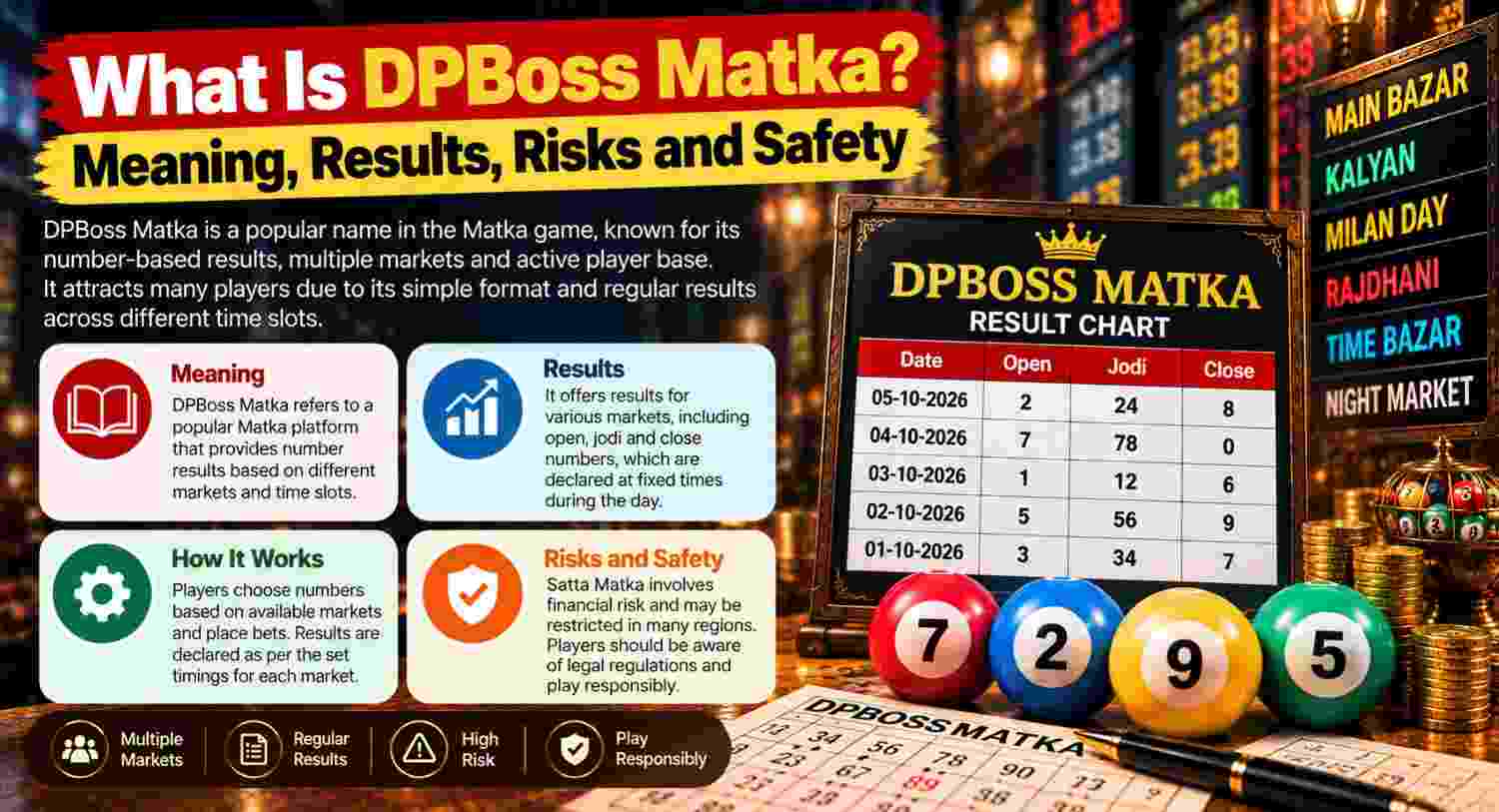
DPBoss Matka generally refers to online information associated with Matka-style gambling, particularly result displays, market names, schedules, historical entries, and related terminology. Readers may encounter the name through search results, shared links, social media posts, or result pages. Viewing such material does not automatically mean a person is gambling. However, Matka belongs to a wagering context, so readers should separate information from participation, treat guaranteed-outcome claims cautiously, protect personal data, and check the legal position that applies in their location.
What DPBoss Matka Generally Refers To
DPBoss Matka is commonly used as a search label for online pages that present information connected with Matka gambling. Such pages may display market names, result-related labels, opening and closing information, historical records, schedules, or status notices. Layout and wording can differ between sources, so readers should not assume that every similar page has the same ownership, accuracy, or authority.
Matka broadly refers to number-based gambling. In online contexts, information about results can appear separately from wagering itself. Someone may read a result page, search an unfamiliar label, examine archived entries, or check what a market name means without placing a bet.
That distinction matters because participation introduces additional risks. Once money, deposits, accounts, or personal information enter an interaction, legal, financial, privacy, and behavioural concerns can arise.
A familiar name also does not prove official status. Search visibility, frequent updates, polished design, or widespread sharing do not establish government recognition, regulatory approval, or verified accuracy.
How Matka Fits Into the Broader Gambling Context
Matka developed as a number-based betting format and later acquired market names, result conventions, and locally used expressions. Online publishing changed how readers encounter this material by making result pages, archived records, timing notices, and related content easily searchable.
For informational purposes, the key point is that Matka-related content concerns gambling outcomes or records connected with wagering activity. Historical background can clarify vocabulary, but past patterns do not become reliable indicators of future outcomes.
Modern pages may mix reported data with promotional material. For example, a page may place past results beside advertisements, contact prompts, prediction claims, or payment requests. Readers should evaluate each element separately because historical information, marketing language, and financial requests carry different risks.
Repeated appearance across several websites also does not prove accuracy. Pages can copy material from other sources, allowing the same error to spread across multiple domains.
Common Terms Seen on Matka-Related Pages
Readers may encounter specialised labels that make a result page difficult to interpret. Definitions should remain descriptive rather than becoming instructions for participation.
Market Names and Schedules
A “market” usually identifies a named Matka-related game, session, or result category. Different pages may list several market names with associated times or status labels. Those names function as identifiers and do not establish official or regulated standing.
Schedules may indicate when a page expects to publish certain information. However, a displayed time does not guarantee an update at that exact moment. Delays, manual entry, technical problems, or copied data can affect publication.
Open and Close Labels
“Open” and “close” commonly appear as result-related labels within Matka terminology. They may identify separate stages or portions of a result cycle. Pages can present those labels in different formats, sometimes beside numbers or historical entries.
Readers seeking context can treat them as structural labels. They do not need calculations, number combinations, or pattern analysis to recognise their general purpose.
Result, Chart, Record, and History
A “result” usually means an outcome reported for a named market or session. A “chart”, “record”, or “history” may organise older reported outcomes by date or market.
Archives can help identify what a source previously published, but they do not make uncertain future outcomes predictable. A long record may look analytical without providing a reliable forecasting basis.
How Result Information Is Commonly Presented Online
Matka-related pages often organise information in compact blocks so readers can scan names, times, status notes, and earlier entries. A page may include market lists, expected update times, current status information, and links to historical records.
Structured layouts can create an impression of precision. Timestamps, repeated labels, and frequently refreshed pages may look authoritative, yet visual organisation does not reveal who supplied the data or how anyone verified it.
Some publishers use words suggesting immediacy around result displays. Such wording describes presentation rather than proving authenticity. A copied or delayed result can still appear under a real-time sounding label.
Historical sections can create further confusion. Long sequences of prior entries may appear to support prediction, but an archive only records what a source claims happened earlier. Apparent patterns do not guarantee future outcomes.
Result information should therefore remain separate from promises about future winnings. A page that moves from reporting data to claiming certainty deserves extra scrutiny.
Why Different Sources May Display Conflicting Results
Conflicting information can arise for several reasons. Matka-related pages may rely on unofficial publishing networks, copied material, manually entered data, or sources that do not disclose how they obtain information.
One page may update later than another. Manual typing can introduce errors, while copied pages may continue showing outdated material after another source changes it.
Duplicate websites and impersonation can add confusion. A page may use familiar wording, branding, or a similar domain name without any verified connection to the source a reader expected. Search ranking does not establish that connection.
Some publishers may also present uncertain information as confirmed or claim advance access to outcomes. Readers should treat such claims cautiously because repetition and visual polish do not replace verification.
If sources disagree, the first or most visible result should not automatically receive greater trust. For informational checking, recognising uncertainty is safer than treating conflicting data as a reason to wager.
Informational Result Checking Versus Gambling Participation
Someone can search DPBoss Matka simply to identify a phrase, interpret page labels, examine archived information, or check material another person shared. Informational viewing usually ends with reading.
Gambling participation differs because it involves staking money or value on an uncertain outcome. Deposits, transfers, financial details, or account creation introduce additional financial, legal, privacy, and behavioural concerns.
The distinction also matters for security. A public page may require no personal data, while a gambling-related interaction may request a phone number, identity documents, bank information, payment credentials, or messaging access.
Readers should separate the credibility of displayed information from the safety of a transaction request. Even if an old result appears accurate, that does not validate a payment demand or personal-data request.
Likewise, seeing result information does not establish that participation is lawful. Applicable rules can depend on jurisdiction, format, and the nature of the activity.
Online Safety and Credibility Checks
Gambling-related searches can expose readers to misleading pages, copied domains, impersonation attempts, aggressive advertisements, and fraudulent payment requests. Basic scrutiny can reduce avoidable digital risk.
Warning signs include:
- promises of guaranteed winnings or certain future results;
- pressure to transfer money immediately;
- requests for passwords, authentication codes, card details, or unnecessary identity data;
- download links from unknown sources;
- pages that imitate another name or layout without clear ownership;
- unsolicited messages offering secret numbers, fixed outcomes, or paid predictions;
- inconsistent contact details or unexplained redirects;
- claims that payment can remove gambling uncertainty.
A high search position does not amount to regulatory endorsement or independent verification. Readers should also treat unknown downloads cautiously because malicious software can create security risks unrelated to result accuracy.
If a page combines result information with financial demands, those issues need separate evaluation. Accurate-looking content does not validate a transaction.
Financial and Behavioural Risks Linked With Matka
Gambling can result in financial loss because a participant places value on an uncertain outcome. No historical chart, paid tip, repeated pattern, or claimed formula removes that uncertainty.
Problems can intensify when someone responds to losses by increasing stakes, borrowing money, hiding spending, or attempting to recover previous losses through further gambling. Such behaviour may deepen financial pressure.
Repeated gambling can also become difficult for some individuals to control. Warning signs include spending more time or money than intended, repeatedly returning after losses, neglecting obligations, or feeling unable to stop despite negative consequences.
Online access may increase exposure because result updates, promotional messages, payment prompts, and gambling discussions can remain readily available. A person seeking distance from gambling may therefore benefit from reducing exposure to triggering pages, messages, or groups.
Anyone facing serious financial or behavioural difficulty should consider appropriate support from qualified local services or trusted support networks.
Legal Considerations in India
Matka-related gambling raises legal questions that require caution because rules can vary by jurisdiction, activity type, and the way a service operates. A blanket statement that every form is legal or illegal everywhere can omit relevant distinctions.
India has central and state-level legal frameworks that can affect gambling or online gaming activity. State rules, enforcement practices, court decisions, and later legal changes can influence how a particular activity receives legal treatment.
Readers considering participation should verify the rules that apply in the relevant state or territory. A result page, advertisement, social post, or private message does not gain legal authority merely by claiming that a service is permitted.
Legal status can also depend on facts that a casual reader cannot determine from a webpage alone, including the structure of the activity and applicable legislation.
Because laws can change, readers should rely on current authoritative legal information when legality matters rather than assuming an old post or generic claim remains accurate.
Common Misconceptions About Results and Predictions
Matka-related content often attracts claims that turn historical information into supposed certainty. Several assumptions require caution.
- Past results predict the next result: Historical sequences describe earlier reported outcomes but do not guarantee what happens later.
- Frequent updates prove official status: Update speed shows publishing activity, not government recognition or verification.
- A polished chart guarantees accuracy: Formatting improves readability but does not validate underlying data.
- Paid predictions remove uncertainty: Charging money for a claim does not make a future outcome certain.
- Repeated numbers reveal a dependable system: Apparent patterns do not reliably predict future results.
- Multiple copied pages confirm a result: Several pages may reproduce the same source, including its errors.
- A familiar name guarantees authenticity: Lookalike pages can copy names, layouts, and wording.
Historical data can show what a source reports about the past. It should not serve as proof of guaranteed future performance.
Privacy, Scams, and Impersonation Risks
A person searching for result information may encounter risks unrelated to gambling outcomes. Fraudsters can exploit familiar names, urgent messages, copied branding, and result-related interest to obtain money or personal data.
Privacy risk rises when a page asks for more information than basic viewing requires. Sensitive details can include identity documents, payment credentials, banking information, authentication codes, or private account access. Sharing them can expose a person to fraud or identity misuse.
Impersonation deserves attention because duplicate pages can look convincing. Small spelling changes in a web address, altered contact details, copied layouts, or unexpected redirects may indicate a different source from the one intended.
Guarantee-based scams often combine urgency with secrecy. Messages may claim access to fixed results or exclusive predictions in exchange for payment. Such claims do not establish control over future outcomes.
Readers seeking public information should question why a page demands money, credentials, or sensitive data before allowing access.
A Practical Way to Read Matka-Related Information
Readers can treat Matka-related pages as unverified informational material rather than as financial opportunities. That framing separates what a page visibly reports from what its publisher claims the information can achieve.
First, identify the content type. A historical record, current status label, advertisement, prediction claim, payment request, and legal statement each require different scrutiny.
Next, distinguish visible facts from claims requiring outside verification. A page can display a number or time, but confident wording cannot prove future certainty. Likewise, familiar design cannot establish official approval.
Readers should also notice contradictions. Different dates, mismatched market names, unexplained changes, duplicate pages, or shifting contact details can indicate weak data handling or impersonation.
Finally, any move from reading to transferring money or personal data requires a separate risk assessment. Information viewing and wagering are different activities, and wagering introduces additional legal, financial, privacy, and behavioural concerns.
A neutral reading approach also means resisting urgency. If a page insists that immediate action is necessary, readers should separate that pressure from the underlying information, verify what can actually be checked, and avoid treating time pressure as evidence of accuracy.
Conclusion
DPBoss Matka generally refers to online information connected with Matka results, terminology, schedules, and historical records rather than an official public information system. Readers should distinguish result viewing from gambling participation, question predictions and guarantees, and avoid assuming that search visibility proves accuracy. Financial loss, privacy problems, scams, and compulsive behaviour can arise around gambling-related services. Because legal treatment can depend on location and activity type, anyone considering participation should check current rules that apply in the relevant jurisdiction.
FAQs
Is DPBoss Matka an official government service?
No. Readers should not assume that a Matka-related name or frequently updated result page represents a government service. Branding, structured displays, and search visibility do not establish official status. If legality or regulation matters, check current information from the relevant public authority rather than relying on a gambling-related page.
Why can Matka result information differ between websites?
Different pages may update at different times, copy information from other sources, contain typing errors, retain outdated entries, or publish unverified material. Duplicate and impersonation pages can add confusion. A disagreement between sources does not automatically reveal which one is correct, so conflicting information deserves caution.
Can historical Matka results predict future outcomes?
No historical sequence can guarantee a future gambling outcome. Archives show what a source reports for earlier dates, but patterns do not create certainty about what happens next. Claims that a chart, formula, paid tip, or repeated sequence guarantees winnings should receive strong scepticism.
Is checking a Matka result the same as placing a bet?
No. Reading displayed information differs from staking money or value on an uncertain result. Gambling participation can introduce financial loss, legal exposure, payment risk, and behavioural concerns. Result pages can still create security risks if they request sensitive information or promote suspicious downloads.
Are gambling laws the same across all of India?
No simplified statement covers every gambling-related activity across every Indian jurisdiction. Applicable rules can depend on state or territory, activity type, online or offline format, and later legal developments. Anyone considering participation should verify current authoritative rules for the specific location and activity.
What signs may indicate a fake or impersonation page?
Warning signs can include lookalike web addresses, unexplained redirects, inconsistent contact details, urgent payment requests, copied branding, suspicious downloads, and guaranteed-result claims. Several signs together justify extra caution. Readers should avoid sharing sensitive credentials merely because a page resembles a familiar source.
Should a result page ask for banking or authentication details?
Public result viewing generally does not require banking passwords, card security details, authentication codes, or account credentials. A request for sensitive financial or login information creates a separate security concern. Readers should treat unnecessary data demands cautiously and avoid sending credentials through unsolicited messages.
Do paid predictions or fixed-result claims guarantee winnings?
No. Payment does not turn an uncertain gambling outcome into a guaranteed one. Claims about fixed results, secret numbers, certain returns, or exclusive advance information can mislead readers and may support scams. Historical data or confident marketing language cannot prove control over future outcomes.
Why does search ranking not prove that a Matka page is reliable?
Search engines rank pages using many relevance and technical signals. High visibility does not equal regulatory approval, independent verification, or guaranteed accuracy. Readers should examine claims, data consistency, security behaviour, and impersonation risks instead of treating search position as proof of authority.
What should readers remember before acting on Matka-related information?
Treat result pages as informational material rather than proof of future outcomes or legal permission to gamble. Be cautious with guarantees, payment requests, sensitive-data demands, downloads, and impersonation. Recognise financial and behavioural risks, and check current rules in the relevant jurisdiction before participating in gambling-related activity.