
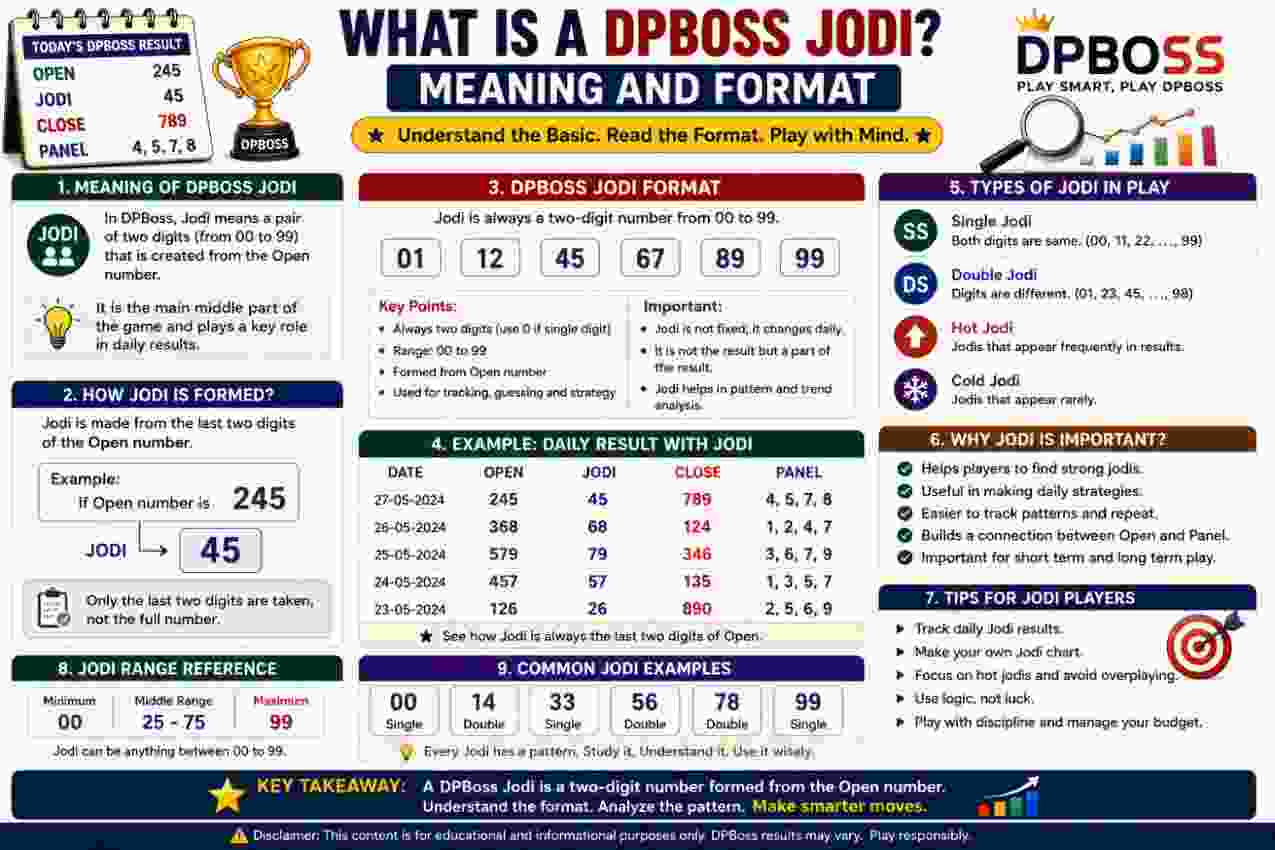
A DPBoss Jodi is a two-digit result formed by combining the final digit of an open panel with the final digit of a close panel. “Jodi” means pair, so every result contains two connected digits. It commonly appears between 00 and 99 in Dpboss matka records. Knowing how this pair forms helps readers interpret charts, separate panels from final results, and check archived entries accurately. However, a Jodi records an outcome; it does not guarantee any future number.
What Does DPBoss Jodi Mean?
A Jodi represents the central two-digit result displayed for a completed market session. The first digit comes from the open side, while the second comes from the close side. These digits create one paired number.
For example, if an open panel produces the digit 6 and a close panel produces the digit 4, the recorded Jodi becomes 64. The order always matters because 64 and 46 represent different pairs.
Why Is It Called a Jodi?
The Hindi word “Jodi” refers to a pair or combination of two connected elements. Within result records, those elements are the open Ank and close Ank.
A Jodi does not consist of two randomly selected digits placed beside each other. Instead, each digit comes from a separate stage of the recorded result. Consequently, reading the underlying panels reveals how the pair reached its final form.
Where Does It Appear in a Result?
A complete result frequently follows a format such as:
Open Panel – Jodi – Close Panel
For instance:
246 – 29 – 360
Here, 246 represents the open panel, 29 represents the Jodi, and 360 represents the close panel. The middle pair gives readers a compact summary of the two panel totals.
Although the middle number attracts considerable attention, readers should check both surrounding panels. Doing so confirms whether the displayed Jodi matches the correct open and close calculations.
How Is a DPBoss Jodi Formed?
The formation process uses simple addition. Each three-digit panel produces one single digit, commonly called an Ank. Combining the open Ank and close Ank creates the Jodi.
Calculating the Open Digit
First, add all three digits in the open panel. If the sum contains two digits, retain only its final digit.
Consider the open panel 246:
- 2 + 4 + 6 = 12
- The final digit of 12 is 2
- Therefore, the open Ank is 2
The open Ank always occupies the first position in the Jodi. In this example, the Jodi must begin with 2.
Calculating the Close Digit
Next, apply the same process to the close panel.
Consider the close panel 360:
- 3 + 6 + 0 = 9
- The final digit is 9
- Therefore, the close Ank is 9
The close Ank occupies the second position. When combined with the open Ank, the final Jodi becomes 29.
Putting the Complete Result Together
The full record now reads:
246 – 29 – 360
This structure shows a clear relationship:
- The open panel 246 produces open Ank 2.
- The closed panel 360 produces closed Ank 9.
- Open Ank 2 and closed Ank 9 form Jodi 29.
Therefore, readers can verify the middle pair without relying solely on the displayed Jodi. A quick addition of both panels confirms whether the record follows the expected format.
What Are Open and Close Digits?
Open and close digits form the two essential parts of every Jodi. Their names describe their positions within a completed result rather than separate types of Jodis.
The Open Ank
The open Ank comes from the total of the three digits in the open panel. It appears first because the open stage precedes the close stage.
Suppose the open panel is 578:
- 5 + 7 + 8 = 20
- The last digit of 20 is 0
- The open Ank becomes 0
If the close Ank later becomes 6, the final pair will read 06. The initial zero remains necessary because a Jodi always contains two digits.
The Close Ank
The close Ank comes from the total of the close panel. It occupies the second position and completes the pair.
Suppose the close panel is 123:
- 1 + 2 + 3 = 6
- The close Ank becomes 6
Combined with open Ank 0, it produces Jodi 06. Removing the zero and writing only 6 would make the format incomplete and potentially confusing.
Why Digit Order Matters
The first and second positions carry different meanings. Jodi 27 begins with open Ank 2 and ends with close Ank 7. In contrast, Jodi 72 begins with open Ank 7 and ends with close Ank 2.
Although both pairs contain the same digits, their sequence changes the recorded result. Therefore, readers should never treat a reversed pair as identical to the original one.
What Does the 00 to 99 Range Represent?
A Jodi can contain any two digits from 0 through 9. This structure creates 100 possible ordered pairs, beginning with 00 and ending with 99.
Single Digits Retain a Leading Zero
Pairs from 00 through 09 require two visible positions. Jodi 04, for example, contains open Ank 0 and close Ank 4. Writing it as 4 removes information about the open side.
Similarly, 01, 02, and 09 remain two-digit records. The leading zero does not act as decoration; it identifies the open Ank accurately.
Double-Digit Jodis
Pairs such as 11, 22, 33, and 44 contain matching open and close digits. People sometimes call them double Jodis because both positions display the same number.
However, matching digits do not require matching panels. Many different open panels can produce one Ank, while numerous close panels can produce the same Ank. Therefore, Jodi 44 only confirms that both panel totals ended in 4.
Different Panels Can Produce the Same Pair
A single Jodi can arise from many panel combinations. For instance, panels 129, 345, and 480 all produce Ank 2 because their sums end in 2:
- 1 + 2 + 9 = 12
- 3 + 4 + 5 = 12
- 4 + 8 + 0 = 12
Consequently, the Jodi alone cannot reveal the exact panel. Readers need the full result to identify which three-digit combinations appeared.
How Do DPBoss Jodi Charts Display Records?
A DPBoss Jodi chart arranges historical pairs by market and date. Instead of showing every panel, some charts display only the final two-digit combinations. This condensed layout helps readers review long records quickly.
Daily and Weekly Layouts
Many charts place dates in rows and market sessions in columns. Other formats group results by week, month, or market name.
Each cell generally contains one Jodi. A blank cell may indicate an unavailable result, a closed session, or an incomplete update. Therefore, readers should not automatically interpret a space as 00.
Full Result Charts and Jodi-Only Charts
A full result chart displays the open panel, Jodi, and close panel. A Jodi-only chart displays the two-digit pair without its supporting panels.
Full charts allow direct calculation checks. Meanwhile, condensed charts make long-range scanning easier. Both formats serve different reading needs, so users should confirm which one they have opened before interpreting an entry.
How to Read a Chart Correctly
A careful reading process follows several steps:
- Confirm the market name.
- Locate the correct date.
- Check whether the chart uses daily or weekly rows.
- Identify the relevant result cell.
- Read both digits in their displayed order.
- Check supporting panels when available.
- Note blanks, symbols, or closed-session marks.
This process reduces errors caused by shifting between neighbouring rows or unrelated market columns.
Why Do Users Check Jodi Records?
Users commonly check Jodi records to confirm a result, review an old entry, compare dates, or interpret a full Dpboss matka chart. Archived pairs can also reveal how the chart organises its information.
Verifying a Published Result
A Jodi chart provides a quick way to check whether a two-digit result matches the recorded market and date. Verification becomes especially useful when users encounter conflicting numbers in separate places.
The market name, session date, and pair must all match. Checking only the digits may be confusing because the same Jodi can appear in several markets or on different dates.
Reviewing Historical Entries
Archived charts preserve earlier pairs in a consistent structure. Readers can locate a particular date without sorting through scattered updates.
Historical records may show repetitions, gaps, and digit frequencies. Nevertheless, these observations describe previous results. They do not establish a fixed rule for future outcomes.
Checking Open and Close Calculations
When a full result appears, users can calculate both panel totals and compare them with the displayed pair. This simple check can reveal typing mistakes or mismatched entries.
For example, the result 148 – 39 – 225 follows the required calculation:
- 1 + 4 + 8 = 13, producing open Ank 3
- 2 + 2 + 5 = 9, producing close Ank 9
- The final Jodi becomes 39
What Is the Difference Between Jodi, Ank, and Panel?
Jodi, Ank, and panel describe connected but distinct elements. Confusing them can cause readers to misread a result or search the wrong part of a chart.
Ank Means a Single Digit
An Ank is one digit from 0 through 9. It comes from the final digit of a panel total.
For example, panel 237 has a total of 12, so its Ank is 2. A single Ank cannot represent a complete Jodi because the pair requires both an open and a close digit.
Panel Means a Three-Digit Combination
A panel contains three digits. It appears on either the open or close side of a full result.
Panels must follow the recognised display structure used by the record. Moreover, their digit totals determine the corresponding Anks. A panel supplies the source calculation, while an Ank supplies its shortened value.
Jodi Means the Final Two-Digit Pair
A Jodi combines the open Ank and close Ank. Therefore, it acts as the central link between both panels.
The relationship can be summarised as follows:
- The open panel produces the open Ank.
- The closed panel produces the closed Ank.
- Both Anks combine to create the Jodi.
Keeping these roles separate makes even a long result chart easier to read.
What Is the Difference Between a Jodi and a Patti?
Patti commonly refers to a three-digit panel combination. Jodi refers to the two-digit result derived from the open and close panel totals.
For example, in 159 – 59 – 126, 159 and 126 function as Pattis or panels, while 59 functions as the Jodi.
Why People Confuse the Two
Both forms appear within the same result line, and informal discussions may use several regional labels. Additionally, users often focus on only one part of the result, which can blur the distinction.
A quick digit count resolves the confusion. A Jodi has two digits, whereas a Patti usually has three digits.
Why the Distinction Matters
Searching for a Jodi chart will generally produce paired records. Searching for a panel or Patti chart will generally produce three-digit combinations.
Consequently, using the correct label helps readers locate the required information and interpret it properly. It also prevents a panel combination from being mistaken for a completed two-digit result.
How Can Users Verify a Jodi Manually?
Manual verification requires only addition and attention to digit order. This method helps readers confirm whether a full result contains the correct central pair.
A Five-Step Verification Method
Follow this sequence:
- Add the three digits in the open panel.
- Retain the final digit of that total.
- Add the three digits in the close panel.
- Retain the final digit of the second total.
- Place the open digit before the close digit.
Consider 357 – 58 – 134:
- 3 + 5 + 7 = 15, so the open Ank is 5
- 1 + 3 + 4 = 8, so the close Ank is 8
- The resulting pair is 58
The displayed result therefore passes the manual check.
What Happens When a Total Ends in Zero?
If a panel total equals 10, 20, or 30, its Ank becomes 0. For instance, panel 460 totals 10, so it produces Ank 0.
Suppose the close panel produces Ank 3. The Jodi becomes 03, not 3. Keeping both positions preserves the distinction between the open and close sides.
Common Mistakes When Reading a DPBoss Jodi
Most Jodi-reading errors come from incorrect dates, reversed digits, neighbouring columns, or confusion between panels and pairs. Careful checking can prevent these problems.
Reversing the Open and Close Digits
A user may read Jodi 36 as 63. This reversal changes the result completely because the open digit must remain first.
Always trace each digit back to its panel total. If the open panel produces 3 and the close panel produces 6, only 36 follows the correct order.
Reading the Wrong Market Column
Charts may place several market names close together. A reader who follows the wrong column can select a genuine result from an unrelated market.
Therefore, locate the market heading first and trace the column downward carefully. Recheck the heading after locating the date, especially on wide charts.
Ignoring the Date Structure
Some charts organise dates vertically, while others use weekly groups. Month changes and closed days can also interrupt the sequence.
Consequently, readers should inspect the complete date label rather than relying on row position. A result from the same weekday in another week does not represent the requested session.
Treating Blank Spaces as Results
A dash, blank cell, or symbol may indicate an unavailable entry. It does not automatically represent Jodi 00.
Chart legends often explain these marks. If no legend appears, readers should avoid assigning a value without supporting information.
Can a Jodi Chart Predict Future Results?
A Jodi chart records completed outcomes. Although users may observe repeats, gaps, or digit sequences, historical arrangements cannot guarantee the next pair.
Patterns Can Appear Naturally
Any long number record will contain clusters, reversals, repeated pairs, and extended absences. These features can look meaningful because human attention searches for order.
However, a visible pattern does not prove that the same sequence will continue. The record only confirms what happened earlier.
Frequency Does Not Create Certainty
A frequently appearing pair may seem likely to appear again. Conversely, a missing pair may seem overdue. Neither assumption provides certainty.
Historical frequency describes a selected period, and a different date range may produce another pattern. Therefore, responsible chart reading separates factual record review from unsupported forecasting.
Claims of Fixed Jodis Require Caution
Statements promising a fixed, sure, or guaranteed Jodi create unrealistic expectations. No archived chart can verify an outcome that has not occurred.
Users should also treat edited screenshots, incomplete prediction records, and success-only claims cautiously. Reliable information reports results clearly without presenting speculation as fact.
How Can Users Read Jodi Information Responsibly?
Responsible reading focuses on accuracy, context, and personal limits. It treats charts as information records rather than guaranteed prediction systems.
Check the Complete Context
Before accepting a displayed pair, confirm:
- Market name
- Session date
- Open panel
- Close panel
- Jodi order
- Chart format
- Update status
These checks take little time and prevent many avoidable mistakes.
Separate Records From Predictions
A completed Jodi belongs to the historical record. A number suggested before completion remains a prediction, regardless of how confidently someone presents it.
This distinction matters because prediction pages may imitate the appearance of result charts. Look for clear date labels and completion indicators before treating any number as a recorded outcome.
Maintain Legal and Financial Awareness
Rules governing number-based wagering differ across locations. Users should check applicable local laws and avoid unlawful activity.
Additionally, no Jodi calculation should influence essential spending, borrowing, or attempts to recover losses. Historical data cannot remove financial risk or guarantee a favourable result.
Conclusion
A DPBoss Jodi is the two-digit pair created by combining the open Ank with the close Ank. Each Ank comes from the final digit of its corresponding three-digit panel total. The pair ranges from 00 to 99, and its order always matters. By checking dates, markets, panels, and calculations, readers can interpret Dpboss matka records accurately. However, historical Jodis document completed outcomes and cannot guarantee future results.
FAQs
What does a DPBoss Jodi represent?
A DPBoss Jodi represents the two-digit pair formed from the open Ank and close Ank. The open digit appears first, while the close digit appears second. It sits between the open and close panels in a full result and summarises the final digit of each panel total.
How many possible Jodi combinations exist?
There are 100 possible ordered pairs, ranging from 00 through 99. Each position can contain any digit from 0 to 9. Because order matters, 24 and 42 count as separate combinations, even though both contain the same two digits.
How does a panel create an Ank?
Add the three panel digits and retain the final digit of the total. For example, panel 489 totals 21, so it produces Ank 1. The same method applies to open and close panels before their respective Anks combine into one Jodi.
Why does a Jodi sometimes begin with zero?
A leading zero shows that the open panel total ended in 0. If the close panel produces Ank 7, the completed pair becomes 07. Removing the initial zero would hide the open digit and leave the result in an incomplete format.
Are Jodi and panel the same thing?
No. A Jodi contains two digits and combines the open and close Anks. A panel contains three digits and produces one Ank through addition. A complete result usually contains two panels with the Jodi displayed between them.
Can different panels produce the same Jodi?
Yes. Many three-digit panels can produce the same Ank because their totals share the same final digit. Consequently, numerous open and close panel combinations can create an identical Jodi. The pair alone cannot identify the exact panels that produced it.
Can old Jodi records confirm a future pair?
No. Old records can confirm previous outcomes and show frequencies, repetitions, or gaps. They cannot guarantee a future pair. Apparent patterns may arise naturally within long number sequences, so readers should treat archived charts as records rather than certainty-based forecasting tools.