
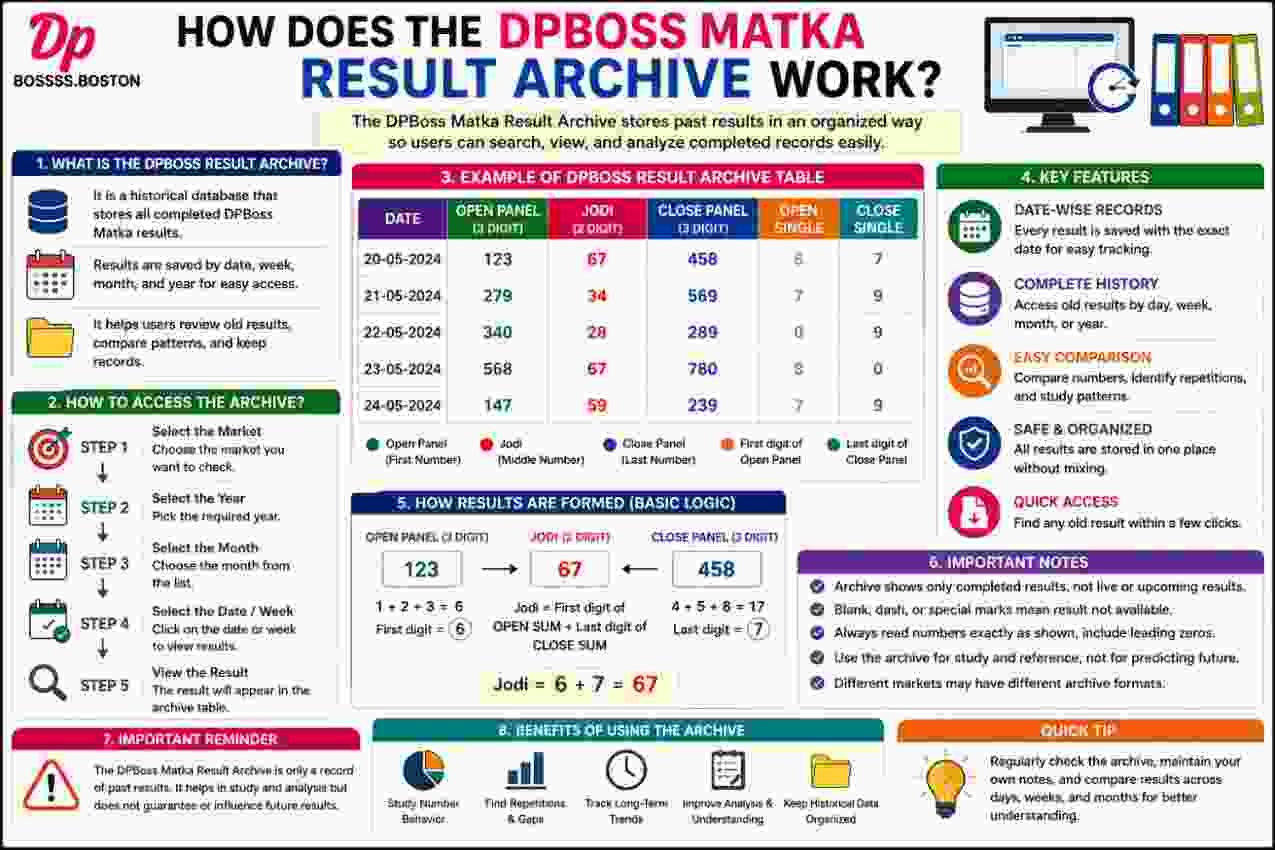
A result archive stores completed numerical records in chronological order, helping readers locate specific dates, Jodi values, panels, and related entries. Although an archive may contain several years of data, its structure usually follows a predictable hierarchy of years, months, weeks, and days. Clear labels and consistent columns make historical retrieval easier, while blanks and closure markers preserve gaps without shifting later results. Accurate reading requires careful attention to dates, digit order, and record type. Historical archives document previous outcomes only; they cannot provide certainty about future results.
What Is a Result Archive?
A result archive is an organised collection of records. Instead of showing only the latest entry, it preserves earlier information under corresponding dates.
The archive may contain Jodi results, opening and closing digits, three-digit panels, or complete result combinations. Moreover, annual and monthly divisions allow readers to navigate large quantities of information without scanning one uninterrupted list.
The Core Purpose of an Archive
An archive performs several practical functions:
- Preserves completed historical records
- Connects every result with a date
- Separates different months and years
- Supports quick retrieval of older entries
- Shows closures and unavailable records
- Keeps Jodi and panel information organised
- Reduces confusion between matching results
Consequently, the archive acts as a historical reference system rather than a collection of isolated numbers.
Common Information Stored
Depending on the layout, an archive may display:
- Full dates or weekly date ranges
- Two-digit Jodi values
- Opening single digits
- Closing single digits
- Opening three-digit panels
- Closing three-digit panels
- Closed-session indicators
- Missing-data placeholders
Some archives show only Jodi records, while others provide full panel details. Therefore, readers should identify the displayed record type before selecting any value.
How Historical Records Are Organised
Most archives arrange information chronologically. Earlier entries may appear first, or the layout may display newer periods above older ones.
Regardless of direction, visible year and month headings should separate major periods. Meanwhile, rows and columns connect individual dates with their corresponding results.
Yearly Sections
Yearly divisions create the broadest level of organisation. Each annual section contains monthly blocks or continuous weekly rows covering that period.
Visible year markers prevent identical day-and-month combinations from becoming confused. For example, 12 August may appear in several annual sections, yet each occurrence represents a separate record.
Monthly Blocks
Monthly headings divide the annual archive into smaller portions. These sections help readers move directly to a required period before searching for a specific date.
A monthly boundary may use:
- A bold heading
- Additional spacing
- A coloured strip
- A thick border
- A separate page
- An expandable digital section
Additionally, the first or final week of a month may contain blank cells when the weekly range crosses a monthly boundary.
Weekly and Daily Rows
Many archives organise results by week. One row may contain a date range followed by separate weekday entries.
In contrast, a daily layout assigns one horizontal row to each date. Both formats preserve chronological order, although their reading methods differ slightly.
Recognising Different Result Formats
Historical archives often store more than one numerical format. Beginners should separate Jodi, single-digit, and panel records before attempting comparisons.
Each format carries a distinct number of positions and appears in a predictable part of the layout.
Two-Digit Jodi Results
A Jodi contains two ordered digits. The first represents the opening position, while the second represents the closing position.
Examples include:
- 03
- 18
- 42
- 70
- 99
Digit order matters. Therefore, 18 and 81 represent separate entries, even though they contain the same two digits.
Single-Digit Results
Some archives display opening and closing digits separately. These values range from 0 through 9.
A complete Jodi combines both positions. For example, an opening digit of 4 and closing digit of 7 produce the pair 47.
Three-Digit Panels
Panel records contain three digits in a fixed sequence. A complete display may show an opening panel, central Jodi, and closing panel.
For example:
137 — 14 — 569
In this display, 137 represents the opening panel, 14 represents the Jodi, and 569 represents the closing panel. Rearranging any panel digits changes the recorded value.
How to Navigate the Archive
A fixed retrieval sequence helps readers locate historical information accurately. Begin with broad period labels, then narrow the search until reaching the required cell.
This method reduces accidental selection of a matching date from the wrong month or year.
Step 1: Confirm the Archive Heading
Check which type of result collection appears on the page. Similar grids may store different datasets, so the heading provides essential context.
Look for:
- The record category
- Jodi or panel identification
- The visible period
- Any explanatory labels
- Opening and closing column names
Only continue when the heading matches the required historical record.
Step 2: Identify the Year
Locate the correct annual section. Do not assume that the first visible entries belong to the required year because some archives display recent records first.
If the year appears only once above a long section, keep that marker in mind while scrolling. Moreover, verify the annual heading again before copying any result.
Step 3: Select the Month
Move to the correct monthly block. Month names, abbreviations, or numbers may identify each division.
Watch for weekly rows that cross from one month into another. In such cases, confirm the full date rather than relying solely on the section heading.
Step 4: Locate the Week or Date
Find the row containing the required date. A daily layout makes this step direct because the full date usually appears beside the result.
For a weekly layout, check both ends of the displayed date range. Then, identify which weekday column corresponds with the target date.
Step 5: Read the Correct Cell
Follow the selected row and column to their intersection. The number in that cell belongs to the chosen date.
Finally, trace the cell back to the date once more. This verification helps prevent cross-row or cross-column reading errors.
Reading a Weekly Archive Layout
Weekly layouts place several daily entries within one row. They save space but require careful attention to weekday positions.
A row may cover Monday through Saturday, although some archives use a different operating schedule.
Identify the Starting Day
Check the weekday headers before counting cells. Never assume that the first column represents Monday because the archive may begin with another day.
For example, if a row covers 4 August through 9 August and begins on Monday, the six cells represent:
- Monday, 4 August
- Tuesday, 5 August
- Wednesday, 6 August
- Thursday, 7 August
- Friday, 8 August
- Saturday, 9 August
The position of each cell determines its date.
Use the Date Range as an Anchor
Keep the weekly range visible while moving across the row. On a wide digital chart, horizontal scrolling may hide the date column.
Before scrolling, note the row position or use a visual marker. Otherwise, the eye may move to a neighbouring line.
Handle Short Weeks Carefully
Holiday periods or monthly boundaries may produce incomplete weekly rows. Blank cells can appear before the first recorded date or after the final date.
Do not count these spaces as active results unless the headers confirm their corresponding dates.
Reading a Daily Archive Layout
Daily layouts usually offer a simpler structure. Each row contains one date and one or more related result fields.
However, dense formatting can still cause mistakes when several rows sit close together.
Start With the Full Date
Identify the day, month, and year before moving horizontally. A full date provides stronger context than a shortened day number.
If the archive lists only the day inside a monthly block, confirm the surrounding month and year headings first.
Move Across One Row
Trace the chosen date horizontally through its result columns. Depending on the archive, these columns may contain:
- Opening panel
- Opening digit
- Jodi
- Closing digit
- Closing panel
Maintain the row position throughout the process. Alternating background colours or borders may help separate adjacent records.
Return to the Date
After reading the result, move back to the date column. This quick check confirms that every numerical component belongs to the same session.
Consequently, the reader avoids combining an opening panel from one row with a closing panel from another.
Reading Jodi Records Correctly
A Jodi result always contains two ordered positions. Accurate interpretation requires preserving both digits, including any leading zero.
The pair should remain connected to its date and should not merge with neighbouring panel values.
Separate Opening and Closing Positions
For the Jodi 46:
- Opening digit: 4
- Closing digit: 6
- Complete pair: 46
Reversing the positions creates 64, which represents a different historical record.
Preserve Leading Zeroes
Pairs from 00 through 09 require a visible zero in the opening position. Therefore, 07 should remain 07 rather than 7.
Removing the zero can:
- Hide the two-position structure
- Create confusion with a single digit
- Affect sorting in spreadsheets
- Change copied historical records
When transferring data, store the pair as text if automatic formatting removes leading zeroes.
Distinguish Jodi Values From Dates
Dates and pairs may both contain two digits. Their positions clarify their functions.
A date appears in a labelled column or weekly range. Meanwhile, a Jodi appears inside a result cell beneath a weekday or record heading.
Reading Panel Records Correctly
Panel sections provide more detail than Jodi-only records. They usually connect opening and closing three-digit values through a central pair.
A full record must preserve the order and position of every digit.
Read the Opening Panel
The opening panel appears before the Jodi in many layouts. Treat its three digits as one ordered group.
For example, 137 differs from 173 and 731. Although these groups use the same digits, their sequence creates separate records.
Read the Central Jodi
The central pair links the opening and closing sides. Its first position corresponds with the opening digit, while its second position corresponds with the closing digit.
Bold text or contrasting colour may make the Jodi easier to locate. Nevertheless, verify that it remains aligned with the correct panels and date.
Read the Closing Panel
The closing panel usually appears after the pair. Like the opening panel, it contains three ordered digits.
Spacing and borders should separate the closing digit from the panel. If several digits appear close together, check the headers before treating them as one continuous number.
How to Handle Missing and Closed Records
An archive may not contain a complete result for every expected date. Closures, unavailable information, and incomplete records create visible gaps.
Accurate archives preserve these gaps rather than filling them with unsupported values.
Common Closure Markers
A closed session may appear as:
- A dash
- A blank cell
- A cross
- A closure label
- A defined symbol
- A shaded position
The archive should explain its chosen convention. However, readers should avoid assuming that every blank carries the same meaning.
Blank Does Not Mean Zero
An empty cell does not automatically represent 0 or 00. It may indicate that no result entered the archive for that date.
Similarly, readers should never move the next visible value into the empty position. Every result must remain attached to its original cell.
Incomplete Panel Entries
Sometimes an archive may display an opening panel while the closing section remains unavailable. Record only the visible information and mark the remaining fields as incomplete.
Guessing missing values would alter the historical record. Therefore, uncertainty should remain visible until reliable information becomes available.
Using Search and Navigation Features
Large digital archives may provide features that reduce manual scrolling. Search controls, annual menus, and collapsible monthly sections can make historical retrieval faster.
Nevertheless, readers should verify the displayed date after using any navigation feature.
Year and Month Selectors
A selector may allow readers to choose a specific annual or monthly period. After making a selection, check the heading above the displayed results.
Occasionally, a page may retain an earlier selection during navigation. Confirming the label prevents accidental use of stale information.
On-Page Search
A browser search can help locate a distinctive date or heading. However, searching for a common pair may return numerous matches.
For better accuracy, search for:
- A full month name
- A complete date
- A unique year label
- A specific section heading
After finding the text, inspect the surrounding row rather than copying the first nearby number.
Expandable Sections
Some archives place monthly or yearly data inside expandable areas. Opening one section should reveal its records without changing their order.
Check whether multiple sections remain open simultaneously. Otherwise, similar rows from separate periods may appear close together during scrolling.
Checking Archive Accuracy
A clear archive still requires careful reading. Verification protects against transcription errors, misaligned rows, and automatic formatting changes.
A short checking routine improves confidence in every historical entry.
Apply a Record Checklist
Before accepting a result, confirm:
- The heading matches the required record.
- The selected year is correct.
- The month matches the target date.
- The weekly row includes that date.
- The weekday column matches the day.
- The Jodi contains two positions.
- Each panel contains three digits.
- Leading zeroes remain visible.
- All components occupy one row.
- No blank contains an assumed value.
If any detail remains uncertain, repeat the search from the annual heading.
Check Digit Transcription
Some digits look similar in small or blurred text. Common visual confusions include:
- 1 and 7
- 3 and 8
- 5 and 6
- 0 and 8
- 6 and 9
Enlarge the screen when necessary. Moreover, compare the copied value character by character with the original cell.
Verify Date Formatting
Automatic tools may convert a pair into a date or change a date into another regional format. Inspect transferred information immediately after copying.
A pair such as 03 may lose its leading zero, while an entry such as 10-11 may become a calendar date. Text formatting can protect the intended display.
Comparing Historical Periods
The Dpboss Matka result archive can support descriptive comparisons between completed periods. Consistent rows and columns allow readers to examine recurring pairs, date intervals, or panel combinations.
However, comparison should remain factual and limited to recorded information.
Compare Equivalent Fields
Compare Jodi values with other Jodi values and panels with other panels. Mixing different formats produces unclear results.
Similarly, use equivalent date ranges. A full month provides a stronger comparison with another full month than with an incomplete weekly section.
Keep Repetitions Attached to Dates
A repeated pair may appear on several unrelated dates. Record each occurrence separately.
For example:
- 6 January: 24
- 18 April: 24
- 11 September: 24
These entries share the same pair but retain different historical contexts.
Separate History From Certainty
A repeated value only shows that the archive contains multiple occurrences. It does not prove that the same result will appear again at a specific time.
Likewise, a long absence does not make a pair certain or overdue. Historical records describe completed events, not guaranteed future sequences.
Maintaining a Personal Record Copy
Readers may create a separate copy for sorting or historical review. A consistent format protects accuracy and makes later checking easier.
Every copied line should retain enough context to remain meaningful outside the original archive.
Recommended Fields
A structured record may include:
- Full date
- Weekday
- Opening panel
- Opening digit
- Jodi
- Closing digit
- Closing panel
- Status note
- Verification marker
Jodi-only records may omit panel fields. However, the full date and two-digit format should remain present.
Use Consistent Labels
Select one naming system and apply it throughout the copied archive. Do not alternate between shortened and full labels without a clear reason.
Consistency supports sorting, searching, and comparison. Additionally, it reduces confusion when records cover several years.
Preserve Original Values
Copy values exactly as displayed. Do not rearrange panel digits, remove zeroes, or fill blank cells from assumptions.
If a value appears unclear, mark it as unverified. An uncertainty label protects record quality more effectively than an unsupported correction.
Common Archive Reading Mistakes
Most errors result from rushing past dates or misreading the grid. Recognising these problems helps readers build a reliable retrieval process.
Choosing the Wrong Year
The same date appears annually. Therefore, always verify the year before selecting a result.
Selecting the Wrong Weekday
A correct weekly row can still produce an incorrect result when the reader uses the wrong weekday column. Trace the header down to the chosen cell.
Reversing a Jodi
Pairs such as 16 and 61 contain identical digits in opposite positions. Read from left to right and preserve the displayed order.
Dropping Leading Zeroes
Values such as 04 and 09 need both positions. Removing the first zero damages the original format.
Crossing Between Rows
Dense charts may cause readers to combine fields from neighbouring dates. Follow one horizontal line and return to the date after reading the result.
Assuming Blank Values
A blank does not automatically represent zero, closure, or missing information. Check the archive’s formatting convention before assigning meaning.
Responsible Use of Historical Archives
Historical archives provide an organised method for retrieving completed records. Their usefulness comes from structure, chronology, and accurate preservation.
However, they cannot establish guaranteed future outcomes.
Use Records for Historical Reference
Appropriate archive use includes:
- Locating a past result
- Checking a date
- Reviewing a Jodi entry
- Comparing completed periods
- Finding repeated historical values
- Confirming opening and closing panels
- Identifying missing records
These activities rely on information already stored in the archive.
Avoid Predictive Certainty
Historical frequency, repeated digits, and visible sequences may attract attention. Nevertheless, none of these features can confirm what an unrecorded outcome will be.
Therefore, responsible interpretation separates factual archive retrieval from unsupported prediction.
Conclusion
A well-structured result archive arranges years, months, weeks, dates, Jodi values, and panels within a consistent historical framework. Accurate navigation begins with the archive heading and narrows through the year, month, weekly range, and weekday. Readers should preserve digit order, retain leading zeroes, respect blank cells, and verify every copied result against its date. Moreover, Dpboss Matka archive records should support factual historical review rather than claims about future certainty. Careful reading turns a dense numerical grid into an accessible and reliable record collection.
FAQs
What information does a result archive usually contain?
A result archive may contain dates, weekly ranges, two-digit Jodi values, opening and closing digits, three-digit panels, and closure markers. Its exact fields depend on the record type. Yearly and monthly divisions keep the information organised and help readers retrieve older entries accurately.
How can readers find a result for a specific date?
First, confirm the archive heading and year. Next, locate the correct month and weekly range. Then, identify the weekday column that matches the target date. Read the value at the row-and-column intersection and trace it back to the date before recording it.
Why must leading zeroes remain in Jodi results?
A leading zero preserves the pair’s two-position format. For example, 06 contains an opening digit of 0 and a closing digit of 6. Removing the zero makes the entry look like a single digit and can create errors during transcription, sorting, or historical comparison.
What should readers do when an entry appears blank?
Readers should check the archive’s closure or missing-data convention. A blank may represent a closed session, unavailable result, or unused date position. They should not treat it as zero, guess the missing value, or shift another result into that cell.
How do Jodi records differ from panel records?
A Jodi record contains a two-digit pair, while a panel record contains an ordered three-digit group. Full panel layouts may display an opening panel, central Jodi, and closing panel. Readers should verify the section heading and column labels before selecting or copying either format.
Can historical results confirm a future outcome?
No. An archive documents completed records and supports date-based retrieval or comparison. Repeated pairs, long gaps, and visible sequences describe earlier data only. They cannot guarantee when or whether a particular value will appear again, so readers should avoid treating historical patterns as certainty.