
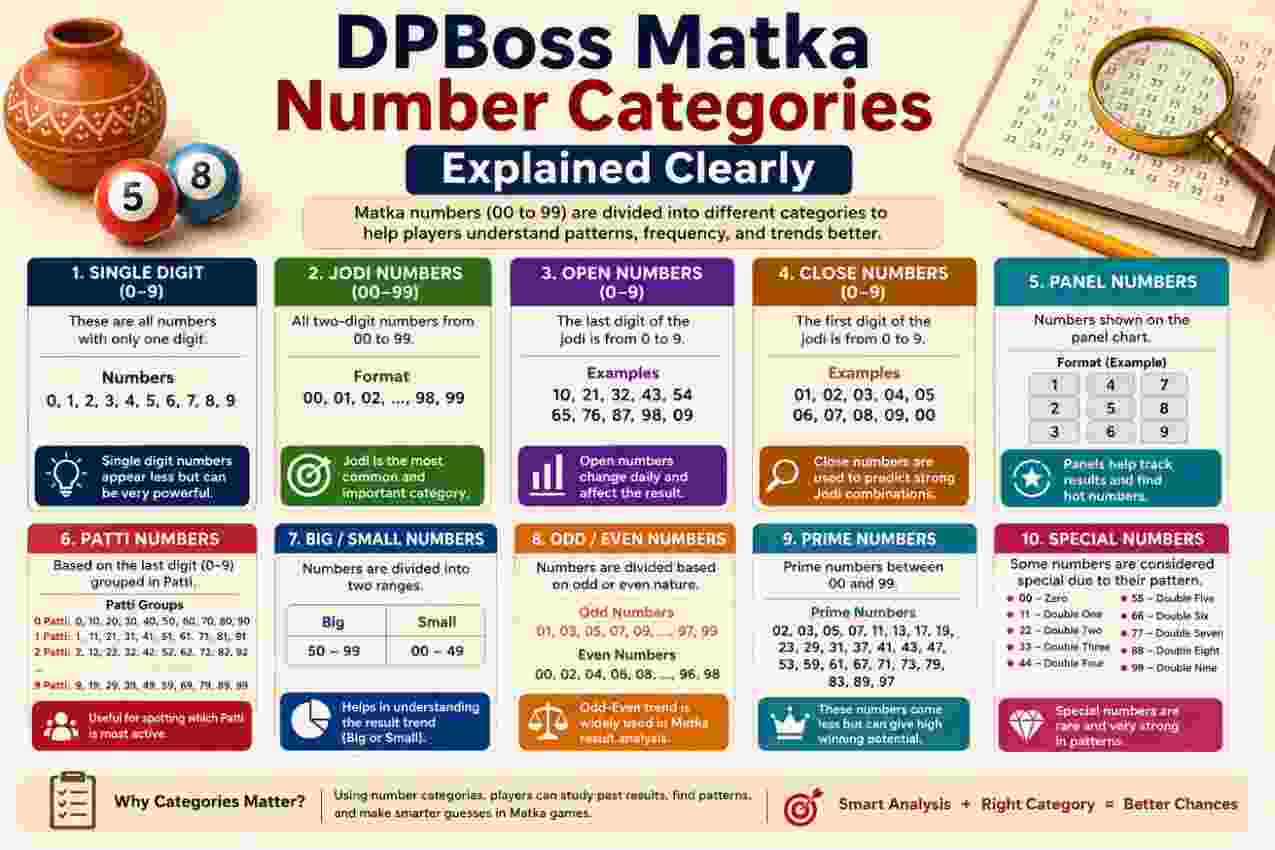
Dpboss Matka records contain several number categories that serve different purposes within a published result. A sequence may include single digits, two-digit pairs, three-digit panels, opening values, and closing values. Without clear category knowledge, readers can easily misread a result or confuse one section with another. Each format follows a distinct numerical structure and occupies a particular position in the record. Knowing how these categories connect helps readers examine archived entries accurately, follow result layouts, and separate recorded information from unsupported assumptions about future outcomes.
Why Do Matka Results Use Different Number Categories?
Matka records divide numerical information into categories because one long sequence would be difficult to interpret. Each category represents a specific part of the recorded outcome. Consequently, the structured arrangement makes daily entries easier to read, compare, and archive.
The main categories usually include single digits, Jodi numbers, three-digit panels, opening results, and closing results. Moreover, some record formats display a complete sequence that combines several categories.
A standard full result may appear as:
137-10-569
This sequence contains two three-digit panels and one two-digit Jodi. However, each component also produces or represents a single digit through a defined calculation.
Categorisation provides several practical benefits:
- It separates individual result stages.
- It maintains a consistent record format.
- It supports date-based comparisons.
- It reduces confusion between pairs and panels.
- It helps readers verify archived outcomes.
- It allows charts to present large datasets neatly.
Therefore, readers should examine every component separately before interpreting the complete entry.
Single-Digit Numbers
A single digit forms the smallest category in a Matka result. It ranges from 0 to 9 and usually comes from the total of three digits within a panel. Although it appears simple, the single digit plays an important role in connecting panel values with the final Jodi.
The Basic Single-Digit Range
The single-digit category contains ten possible values:
- 0
- 1
- 2
- 3
- 4
- 5
- 6
- 7
- 8
- 9
A result cannot produce a single digit outside this range. When a panel total contains two digits, only the final digit becomes relevant.
For example, consider the panel 137:
1 + 3 + 7 = 11
The last digit of 11 is 1. Therefore, the single digit linked with panel 137 is 1.
Similarly, panel 569 produces:
5 + 6 + 9 = 20
The last digit is 0. Consequently, its associated single digit is 0.
How Zero Appears as a Single Digit
Zero often creates confusion because readers may expect every total to end between 1 and 9. However, any panel total ending in zero produces the single digit 0.
For instance:
2 + 3 + 5 = 10
Thus, panel 235 connects with 0. Likewise, 460 totals 10 and produces the same single-digit value.
Zero remains a valid result category rather than an empty value. Therefore, readers should retain it when recording or comparing entries.
The Function of Single Digits
Single digits usually connect the opening and closing panels. The opening panel produces the first single digit, while the closing panel produces the second. Together, these values form a two-digit Jodi.
This relationship makes single digits essential for checking whether a complete result is internally consistent. If the panel totals do not match the displayed pair, the record may contain a typing, copying, or formatting error.
Jodi Number Categories
A Jodi is a two-digit pair ranging from 00 to 99. It combines the single digit derived from the opening panel with the single digit derived from the closing panel. As a result, one complete record can connect two panels through a central pair.
How a Jodi Forms
Consider this result:
137-10-569
The opening panel is 137:
1 + 3 + 7 = 11
The last digit is 1.
Meanwhile, the closing panel is 569:
5 + 6 + 9 = 20
The last digit is 0.
Combining the opening digit 1 and closing digit 0 creates the Jodi 10.
The first digit always reflects the opening side, whereas the second reflects the closing side. Reversing them would create 01, which represents a different pair.
Jodi Range and Formatting
The Jodi category contains 100 possible combinations, beginning with 00 and ending with 99. Numbers below 10 retain a leading zero because every Jodi requires two positions.
Examples include:
- 00
- 03
- 09
- 10
- 27
- 54
- 88
- 99
Writing 03 as 3 removes an important part of its structure. Therefore, charts and historical records preserve both digits.
Repeated and Mixed Jodis
Jodi numbers can contain matching or different digits. A pair with matching digits, such as 11, 44, or 77, is commonly called a double Jodi. In contrast, pairs such as 18, 42, and 90 contain different digits.
The structural distinction helps organise records, but it does not establish a future pattern. Historical repetition only shows that a pair appeared more than once in past entries.
Reversed Jodi Pairs
Two Jodis may contain the same digits in opposite positions. For example, 27 and 72 are reversed pairs. Although they use identical digits, they remain separate recorded outcomes because opening and closing positions matter.
Similarly, 04 differs from 40. Careful readers should preserve the original order when copying entries into notes, spreadsheets, or comparison records.
Three-Digit Panel Numbers
A panel contains three digits and represents either the opening or closing part of a complete Matka entry. Dpboss Matka layouts commonly place one panel before the Jodi and another after it. Consequently, readers can identify the opening panel on the left and the closing panel on the right.
Panel Structure
Every panel uses three digits. However, valid panel formats usually follow established digit-order rules rather than displaying every possible three-digit combination.
Examples may include:
- 123
- 137
- 245
- 460
- 569
- 789
Readers should preserve all three digits exactly as displayed. Changing their order can create a different panel or an invalid record.
Opening Panels
The opening panel appears first in the full sequence. Its digit total determines the opening single digit, which becomes the first number in the Jodi.
For example:
245-11-137
The opening panel is 245.
2 + 4 + 5 = 11
Therefore, the opening single digit is 1. The Jodi also begins with 1, confirming the connection.
Closing Panels
The closing panel appears after the Jodi. Its total determines the second single digit within the pair.
Using the same sequence:
245-11-137
The closing panel is 137.
1 + 3 + 7 = 11
Thus, the closing single digit is 1. The complete Jodi becomes 11 because both panel totals end in 1.
Panel Totals Above Nine
Most panel totals produce a two-digit sum. Nevertheless, the category uses only the final digit of that sum.
For example:
7 + 8 + 9 = 24
The relevant single digit is 4.
Similarly:
4 + 6 + 8 = 18
The linked digit is 8.
This method remains consistent regardless of whether the total equals 10, 18, 20, or 24. Therefore, readers do not need to add the digits of the total again. They only retain its final digit.
Single Panna, Double Panna, and Triple Panna
Panel numbers can be divided further according to whether their three digits are different or repeated. These categories describe the internal composition of the panel rather than its opening or closing position.
Single Panna
A single Panna contains three different digits. No digit repeats within the panel.
Examples include:
- 123
- 145
- 260
- 379
- 458
- 680
The category name refers to the absence of repeated digits. However, readers must still follow the accepted panel arrangement shown in the relevant record.
Double Panna
A double Panna contains one repeated digit and one different digit. Therefore, two positions carry the same value.
Examples may include:
- 112
- 166
- 229
- 334
- 557
- 899
Its digit total still determines the linked single digit. For example, 229 totals 13, so its associated digit is 3.
The repeated structure makes double Panna entries visually distinctive. Nevertheless, repetition within a panel does not make it more significant than another archived result.
Triple Panna
A triple Panna contains the same digit in all three positions. Examples include 111, 222, 333, and 999.
For instance:
6 + 6 + 6 = 18
Therefore, panel 666 produces the single digit 8.
Triple Panna records form a small, easily recognised group. Additionally, their repeated appearance may attract attention during historical reviews. Such recurrence, however, cannot confirm what will appear in a later result.
Comparing the Three Panna Categories
The difference depends entirely on digit repetition:
- Single Panna: three different digits.
- Double Panna: two matching digits.
- Triple Panna: three matching digits.
This classification helps readers sort panels efficiently. Moreover, it supports cleaner historical datasets when entries require grouping by structural type.
Open and Close Number Categories
Opening and closing categories identify the stage or position of a number in the complete result. They do not describe the numerical value itself. Accordingly, the same single digit or panel can appear in either position across different records.
Open Single and Open Panel
The open panel appears at the beginning of a full result. Its calculated final digit becomes the open single.
In 137-10-569, 137 serves as the open panel, while 1 serves as the open single.
Some result displays may publish the opening section before the closing section becomes available. In that situation, readers might initially see only the open panel and open single.
Close Single and Close Panel
The close panel completes the result. Its digit total produces the close single, which forms the second half of the Jodi.
In 137-10-569, 569 serves as the close panel, and 0 serves as the close single.
Once both sides appear, readers can verify the entire sequence. Consequently, an incomplete entry should not be treated as a fully recorded result.
Why Position Matters
Position changes meaning. An opening digit of 3 and a closing digit of 7 form 37, while an opening digit of 7 and a closing digit of 3 form 73.
Likewise, the left panel belongs to the opening stage, whereas the right panel belongs to the closing stage. Maintaining this direction prevents errors during chart reading and record transcription.
Full Result and Partial Result Formats
Result pages may present complete or incomplete information depending on the publication stage. Recognising the difference helps readers avoid treating a partial update as a finished entry.
Complete Result Format
A complete result normally contains:
- Opening panel
- Jodi
- Closing panel
For example:
246-22-345
The panel 246 totals 12, producing the opening digit 2. Meanwhile, 345 also totals 12, producing the closing digit 2. Therefore, the central Jodi is 22.
Partial Opening Format
Before the closing stage, a record may show only the opening panel and its linked digit. The remaining spaces may stay blank or display placeholders.
Readers should wait for the closing information before storing the sequence as complete. Otherwise, later comparisons may rely on missing or incorrectly assumed data.
Placeholder Symbols
Dashes, asterisks, blank fields, or similar marks can indicate unavailable information. These symbols do not represent zero. Instead, they usually show that a value has not appeared or has not been entered.
Therefore, readers should never replace a placeholder with 0 unless the published result explicitly records zero.
How Categories Connect in One Result
Each category forms part of a connected numerical structure. The panels produce the singles, and the singles form the Jodi. Consequently, readers can check a result through simple addition.
Consider:
128-19-469
- Opening panel: 128
- Opening total: 1 + 2 + 8 = 11
- Open single: 1
- Closing panel: 469
- Closing total: 4 + 6 + 9 = 19
- Close single: 9
- Jodi: 19
This verification method helps identify transcription mistakes. If the central pair conflicts with either panel total, readers should recheck the source record rather than altering the numbers independently.
Similarly, a neatly formatted sequence may still contain an error. Mathematical consistency provides an additional checking layer, although it cannot confirm whether the original publisher entered the correct panel.
Common Category-Reading Mistakes
Readers often make small formatting or positional mistakes when reviewing extensive Dpboss Matka records. Fortunately, a consistent checking process can prevent most errors.
Dropping Leading Zeros
Writing Jodi 04 as 4 changes a two-digit category into a single digit. Always retain the leading zero in pairs from 00 through 09.
Reversing Open and Close Digits
A pair of 28 does not equal 82. Therefore, record the opening value first and the closing value second.
Confusing Panels With Jodis
Panels contain three digits, while Jodis contain two. A full sequence uses panels on both sides of the central pair.
Treating Placeholders as Results
A blank field or dash generally signals missing information. It should not become zero automatically.
Assuming Repetition Predicts Outcomes
Historical categories describe recorded events. Repeated digits, panels, or Jodis do not establish certainty about later results. Responsible interpretation separates factual records from speculation.
Practical Steps for Reading Category Data
A methodical approach keeps historical review accurate and efficient.
- Check the date and market heading connected with the entry.
- Identify the left three-digit opening panel.
- Add its digits and retain the final digit.
- Read the central two-digit Jodi.
- Identify the right three-digit closing panel.
- Calculate its final digit.
- Compare both calculated digits with the Jodi.
- Preserve leading zeros and original number order.
- Mark incomplete records separately.
- Avoid drawing predictive conclusions from past repetition.
Additionally, readers should use consistent formatting when transferring data. Standardised entries make sorting, filtering, and comparing records much easier.
Conclusion
Dpboss Matka number categories create an organised structure for recording panels, singles, Jodis, and opening or closing values. Each part connects through a simple numerical relationship, allowing readers to verify complete sequences and spot common transcription errors. Clear category recognition also protects leading zeros, number order, and incomplete entries during historical comparison. Most importantly, these formats describe recorded outcomes only. Careful reading supports accurate record interpretation, while responsible analysis avoids presenting repetition or numerical structure as proof of future results.
FAQs
What are the main Dpboss Matka number categories?
The main categories include single digits, two-digit Jodis, three-digit panels, opening numbers, and closing numbers. Panels may also fall into single, double, or triple Panna groups according to digit repetition. Each category serves a separate function within the complete published result.
How does a three-digit panel produce a single digit?
Add all three digits in the panel, then retain the final digit of the total. For example, 246 totals 12, so its linked single digit is 2. If a panel totals 20, the connected single digit becomes 0 rather than 20.
What is the difference between a Jodi and a panel?
A Jodi contains two digits and combines the opening and closing singles. A panel contains three digits and appears on either side of the pair. Therefore, the panels generate the individual digits that form the central Jodi in a complete result.
Why must a leading zero remain in a Jodi?
A Jodi always contains two positions. Consequently, 03 represents an opening single of 0 and a closing single of 3. Writing only 3 removes the opening position and can cause confusion when readers compare, sort, or archive historical records.
Can past number categories indicate future results?
No category can establish a certain future outcome. Historical data only records what appeared previously. Although readers can sort repetitions, compare frequencies, or identify structures, those observations do not provide reliable certainty. Responsible review treats every archived entry as past information rather than a prediction.