
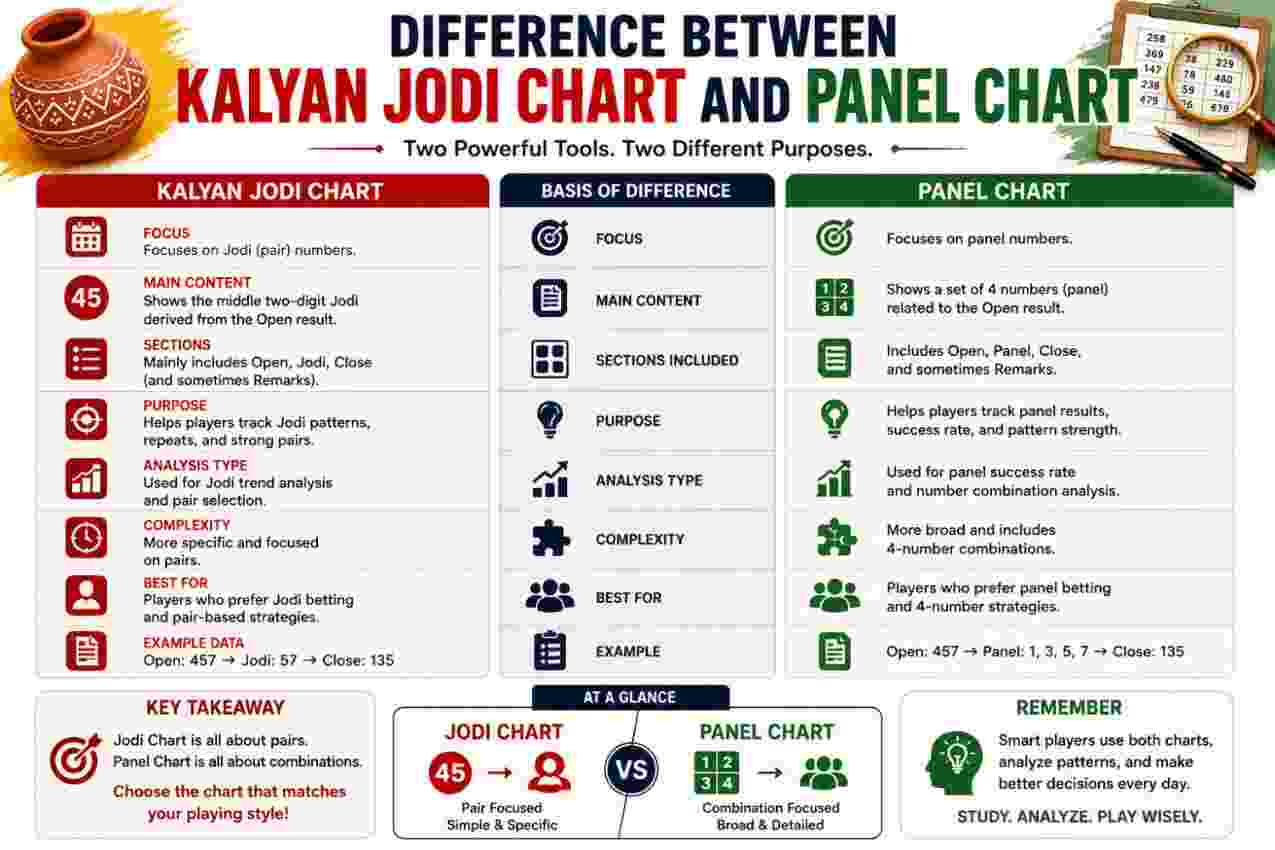
The Kalyan Jodi Chart and panel chart record related results, but they present different levels of detail. A jodi chart shows a two-digit result created from the opening and closing digits. In contrast, a panel chart displays the three-digit combinations that produce those final digits. Both formats help readers verify completed records, yet their layouts, calculations, and uses differ. Recognizing these distinctions prevents date errors, reversed digits, and confusion between compact results and complete panel information.
Basic Meaning of Both Chart Formats
Before comparing the two formats, readers need a clear picture of what each chart records. Although both relate to the same completed session, they display separate parts of the result.
What Is a Kalyan Jodi Chart?
A Kalyan Jodi Chart records two-digit results arranged by date, weekday, week, or month. The first digit represents the opening result, while the second digit represents the closing result. Together, they create a jodi.
For example, an opening digit of 3 and a closing digit of 8 form 38. Therefore, the sequence matters. A jodi of 83 represents a different result because the opening and closing positions have changed.
The compact structure makes this chart useful for checking:
- Final two-digit results
- Past result dates
- Weekly result sequences
- Repeated jodis
- Opening and closing digit pairs
- Missing or closed sessions
However, it normally does not show the complete three-digit combinations behind each digit.
What Is a Panel Chart?
A panel chart records three-digit combinations associated with the opening and closing sides. Each panel contains three digits, and their sum produces a final single digit.
For instance, the opening panel 128 has a total of 11. Since the last digit of 11 is 1, the opening digit becomes 1. Similarly, the closing panel 349 totals 16, producing a closing digit of 6. Consequently, the complete result produces the jodi 16.
A panel chart provides more numerical detail because it preserves both the original combinations and their derived digits.
The Primary Difference at a Glance
The central difference concerns data depth. The jodi format gives the final paired digits, whereas the panel format shows the three-digit combinations used to derive those digits.
Two Digits Versus Three-Digit Combinations
A jodi always contains two positions:
- Opening digit
- Closing digit
A complete panel record usually contains:
- Opening three-digit panel
- Opening single digit
- Closing three-digit panel
- Closing single digit
- Final two-digit jodi
Consequently, the panel format contains more information. The jodi format condenses that information into a faster, more readable result.
Compact Record Versus Detailed Record
The Kalyan Jodi Chart suits readers who need a quick result check. Its cells remain small, so one page can display many weeks or months. Meanwhile, a panel chart requires more space because each session may include two three-digit groups alongside the final digits.
Neither format replaces the other in every situation. Instead, each serves a different recordkeeping purpose. The Jodi chart prioritizes speed, while the panel chart prioritizes detail.
How Numbers Appear in Each Chart
Visual presentation plays a major role in interpretation. Readers who recognize the number patterns can identify the chart type before examining its title or supporting notes.
Jodi Number Presentation
Jodi entries appear as values from 00 to 99. A leading zero remains important, so 04 must appear with both digits. Writing only 4 would remove the opening digit and create ambiguity.
Common jodi forms include:
- Mixed pairs, such as 27 or 63
- Double pairs, such as 11 or 88
- Zero-ending pairs, such as 40 or 70
- Zero-opening pairs, such as 05 or 09
- Reverse pairs, such as 24 and 42
Each entry represents one opening-and-closing combination. Therefore, every position carries a specific meaning.
Panel Number Presentation
Panel entries contain three digits, such as 128, 349, or 567. A complete session generally shows one opening panel and one closing panel. Some charts separate them with the jodi, while others place each component in a dedicated column.
For example, a full result may appear in this sequence:
- Opening panel: 128
- Opening digit: 1
- Closing digit: 6
- Closing panel: 349
- Final jodi: 16
Additionally, panel records may use spacing, color, or vertical alignment to distinguish opening information from closing information.
How Calculations Connect the Charts
The charts do not exist as unrelated systems. Panel calculations create the single digits that later combine into the jodi result.
Calculating the Opening Digit
The opening panel contains three digits. Adding those digits produces a total, and the last digit of that total becomes the opening digit.
Consider the panel 245:
- Add 2, 4, and 5.
- The total equals 11.
- Retain the final digit, which is 1.
- Record 1 as the opening digit.
Thus, the opening side contributes the first position in the jodi.
Calculating the Closing Digit
The closing panel follows the same calculation. Suppose the closing panel is 368:
- Add 3, 6, and 8.
- The total equals 17.
- Retain the final digit, which is 7.
- Record 7 as the closing digit.
The opening digit 1 and closing digit 7 then create the jodi 17.
Why the Calculation Matters
The calculation creates a direct verification link between both charts. If a jodi chart displays 17 while the associated panels produce 1 and 7, the records agree.
However, if the displayed jodi conflicts with the panel totals, at least one entry may contain an error. Consequently, panel data can help check the accuracy of a condensed jodi record.
Differences in Chart Layout
Both formats often use dates and weekdays, yet their space requirements produce noticeably different layouts. A jodi chart usually appears cleaner, while a panel chart can look denser.
Typical Jodi Chart Layout
A jodi chart may place weekdays across the top and weekly date ranges along the left side. Each cell contains one two-digit value. Alternatively, it may list dates vertically with a jodi beside every completed session.
Its layout commonly includes:
- Month and year
- Date or weekly range
- Weekday columns
- Two-digit result cells
- Dashes or blank cells for closed sessions
- Correction marks when necessary
Because entries remain short, readers can scan long historical periods quickly.
Typical Panel Chart Layout
A panel chart needs wider columns or multiple lines within each cell. It may place the opening panel above the jodi and the closing panel below it. Another layout displays all components horizontally.
As a result, panel charts can require sideways scrolling on smaller screens. Moreover, closely packed digits may cause readers to connect the wrong panel with a neighboring date.
Importance of Visual Alignment
Correct alignment protects the meaning of every entry. A shifted row can assign a jodi or panel to the wrong weekday. Similarly, removing a blank cell for a closed session can displace all later results.
Therefore, reliable charts preserve the full date structure, even when no result appears for a particular day.
Difference in the Level of Historical Detail
Historical depth represents another major distinction. A jodi record preserves final pairs, whereas a panel archive retains the numerical components that produced them.
Information Available in Jodi History
A long Kalyan Jodi Chart allows readers to examine:
- Which jodi appeared on a particular date
- How often a pair occurred
- Whether a double jodi appeared
- When reverse pairs occurred
- How many sessions separated repeated values
- Whether records contain missing dates
These observations accurately describe completed results. Nevertheless, they cannot reveal the original panels unless another source preserves them.
Information Available in Panel History
Panel history supports more detailed checking because it records six panel digits across the opening and closing sides. Readers can verify sums, identify repeated three-digit groups, and confirm whether a jodi matches its panels.
Moreover, panel archives preserve information that a jodi-only chart removes during condensation. Once only the final pair remains, many different panel combinations could correspond with the same opening or closing digit.
Limits of Both Historical Formats
Neither chart guarantees a later outcome. Repetition, frequency, gaps, and visual sequences only summarize completed sessions. Although a detailed panel archive contains more numbers, greater detail does not create certainty.
Therefore, readers should separate historical analysis from claims of fixed prediction.
Differences in Reading Speed and Complexity
The quantity of displayed information affects how quickly readers can interpret each format. A short result requires less effort, while a full panel record demands careful calculation and alignment.
Why Jodi Charts Are Faster to Read
A two-digit entry communicates the final opening and closing pair immediately. Readers do not need to add panel digits when they only want to verify a completed jodi.
Additionally, compact cells allow a wider historical range to appear on one page. This feature helps readers compare weeks and months without repeatedly changing sections.
Why Panel Charts Require More Attention
A panel chart presents several values for each session. Readers must distinguish the opening panel from the closing panel and then check the derived digits.
One incorrectly read digit can change the calculation. For example, confusing 358 with 368 changes the total from 16 to 17. Consequently, careful reading matters more when reviewing detailed panel records.
Which Format Is Easier for New Readers?
The jodi format generally feels simpler because it shows only two digits. However, readers still need to recognize opening and closing positions.
Panel charts involve more steps, yet they explain how those positions arise. Therefore, a new reader may begin with jodi structure and then examine panel calculations for fuller context.
How Opening and Closing Results Differ
Both charts depend on the separation between opening and closing results. Confusing these positions can reverse the final jodi or connect panels incorrectly.
Opening Side
The opening side occurs first in the recorded sequence. Its three-digit panel produces the first single digit. That digit then occupies the left position in the jodi.
For example, if an opening panel produces 4, every correctly recorded jodi from that session must begin with 4.
Closing Side
The closing side occurs later and produces the second digit. If its panel total ends in 9, the jodi must finish with 9.
Accordingly, an opening digit of 4 and closing digit of 9 create 49. Reversing the order to 94 changes the recorded result.
Position Errors
Position errors commonly occur when someone copies digits without their labels. A pair written as separate numbers may not reveal which value belongs first.
Panel charts can reduce this confusion when they clearly mark both sides. However, crowded formatting can create new mistakes if opening and closing panels appear too close together.
Common Misinterpretations
Readers sometimes treat the Kalyan Jodi Chart and panel chart as interchangeable. Although the formats connect, several assumptions can distort historical review.
Treating a Jodi as a Panel
A two-digit jodi never functions as a three-digit panel. The jodi records derived digits, while the panel records the original three-number combination.
Consequently, adding the two digits in a jodi does not reconstruct its panels. Numerous panels can produce the same final digit, so missing panel information cannot be recovered through guesswork.
Assuming One Jodi Has Only One Panel Pair
A single digit may come from many three-digit combinations. Therefore, the same jodi can appear with different opening and closing panels on separate dates.
For example, panels totaling 11, 21, or 31 all produce a final digit of 1. The jodi preserves that final digit but removes the complete total and panel combination.
Reading Blank Cells as Zero
Blank spaces usually indicate missing information, closure, or no declared result. In contrast, zero remains an actual digit and must appear explicitly.
A jodi of 00 differs completely from an empty cell. Similarly, a panel that produces zero still requires a recorded three-digit combination if full details remain available.
Assuming Patterns Guarantee Results
Historical clusters can look meaningful, especially when doubles, reverses, or repeated panels appear close together. However, visible arrangements do not establish certainty.
Records describe what occurred. They cannot force the next jodi or panel to follow a sequence.
Verification and Record Accuracy
Accurate archives depend on careful entry, consistent formatting, and correction procedures. The panel format offers more verification detail, but it also creates more opportunities for transcription mistakes.
Checking a Jodi Against Panels
Readers can verify a result through four steps:
- Add the three opening-panel digits.
- Retain the final digit of the total.
- Repeat the process for the closing panel.
- Combine both final digits in opening-to-closing order.
If the resulting pair matches the jodi, the displayed components remain internally consistent.
Finding Transcription Errors
Common mistakes include:
- Reversed jodi digits
- Incorrect panel digits
- Results entered under the wrong date
- Missing leading zeros
- Opening and closing panels exchanged
- Closed days removed from the sequence
- Corrected values left without notation
Moreover, one wrong panel digit may affect both its single digit and the final jodi.
Handling Conflicting Records
When two charts disagree, readers should compare the exact year, month, date, and weekday first. They should then calculate the panel totals and check whether either source marks a correction.
If reliable supporting details remain unavailable, the entry should carry an unverified status. Guessing a replacement weakens the historical archive.
Practical Uses of Each Chart
The most suitable chart depends on the information a reader needs. Selecting the correct format saves time and reduces unnecessary calculations.
When a Jodi Chart Is More Suitable
A Kalyan Jodi Chart works well when the task involves:
- Checking a final two-digit result
- Reviewing long date ranges quickly
- Comparing weekly jodis
- Counting historical appearances
- Locating doubles or reverse pairs
- Confirming opening and closing digits
Its compact design supports rapid scanning, particularly across monthly or yearly records.
When a Panel Chart Is More Suitable
A panel chart proves more useful when readers need to:
- Verify how a single digit was produced
- Check the complete opening combination
- Check the complete closing combination
- Investigate a conflicting jodi
- Preserve detailed historical records
- Identify errors in panel calculations
Thus, panel data supports deeper verification rather than faster browsing.
Using Both Formats Together
Combined records provide the strongest historical context. The Jodi chart offers a concise overview, while the panel chart supplies supporting numerical details.
For example, a reader can locate a date quickly in the Jodi archive and then check the panel record for verification. This method balances efficiency with detail.
Responsible Interpretation of Historical Data
Both chart formats require measured interpretation. Numbers may repeat, disappear for long periods, or form attractive visual sequences without creating a dependable forecast.
Frequency Only Describes the Past
Counting appearances can show how often a jodi or panel occurred within a selected period. However, the count changes when the date range changes.
A value that appears frequently across one month may appear rarely across a year. Therefore, every frequency statement needs a fixed historical period.
Long Gaps Do Not Create Certainty
Some readers assume that a missing jodi must return after a long absence. This belief treats past gaps as schedules, even though the record provides no such guarantee.
Similarly, a recently repeated panel does not become certain to repeat. Historical spacing remains descriptive.
More Data Does Not Remove Uncertainty
A panel chart displays more digits than a jodi chart, but additional data does not create a fixed future result. It merely preserves more details about completed sessions.
Consequently, responsible use focuses on verification, organization, and factual comparison rather than guaranteed claims.
How to Maintain Clear Chart Records
Consistent recordkeeping keeps both formats readable over long periods. Simple standards can prevent most alignment, calculation, and transcription problems.
Essential Fields for a Jodi Record
A properly maintained jodi archive should preserve:
- Complete date
- Weekday
- Opening digit
- Closing digit
- Final jodi
- Closed-session status
- Correction note, when needed
Including separate opening and closing fields can help prevent reversed pairs.
Essential Fields for a Panel Record
A detailed panel archive should include:
- Opening three-digit panel
- Opening total or final digit
- Closing three-digit panel
- Closing total or final digit
- Final jodi
- Date and session status
Additionally, standard spacing should clearly separate both sides.
Preserving Historical Integrity
Recordkeepers should verify every calculation before storing the result permanently. Corrections should include a clear mark rather than silently replacing earlier data.
Meanwhile, backups protect older records from loss. If a source remains incomplete, the archive should preserve the gap instead of inserting an assumed value.
Conclusion
The Kalyan Jodi Chart presents final opening and closing digits as one compact two-digit result, while a panel chart preserves the three-digit combinations behind those digits. Jodi records support quick historical checking, whereas panel records offer deeper calculation and verification details. Both formats depend on correct dates, clear opening and closing positions, and accurate alignment. When used together, they create a fuller record of completed sessions. However, neither repetition nor added numerical detail guarantees any future outcome.
FAQs
Is a Kalyan Jodi Chart the same as a panel chart?
No. A jodi chart displays a two-digit result formed by the opening and closing digits. A panel chart records the three-digit combinations that produce those digits. Although both formats represent the same completed session, the panel version preserves substantially more numerical detail.
Can a panel chart verify a Jodi result?
Yes. Add the three opening-panel digits and retain the total’s final digit. Then perform the same calculation for the closing panel. Combining those derived digits in opening-to-closing order produces the jodi. If the pair matches the displayed result, the records remain internally consistent.
Why can different panels produce the same jodi?
Many three-digit combinations can produce totals ending in the same digit. For example, totals of 12, 22, and 32 all produce a final digit of 2. Consequently, different opening and closing panels can create identical jodi results on separate dates.
Which chart is easier to read?
A jodi chart generally allows faster reading because each session uses only two digits. A panel chart requires closer attention since it contains two three-digit groups and their derived values. However, the detailed format offers stronger support when readers need to check calculations or investigate conflicting entries.
What does a blank space mean in either chart?
A blank space may indicate a closed session, missing record, delayed entry, or unavailable historical information. It does not automatically represent zero. Valid zero results must appear explicitly within a jodi or through a panel calculation that ends in zero.
Can either chart provide a guaranteed future result?
No. Both charts preserve completed outcomes and support historical comparison. Repeated jodis, recurring panels, long gaps, doubles, and reverse pairs may attract attention, but none creates certainty. Readers should use the records for factual checking and organization rather than treating them as fixed predictions.