
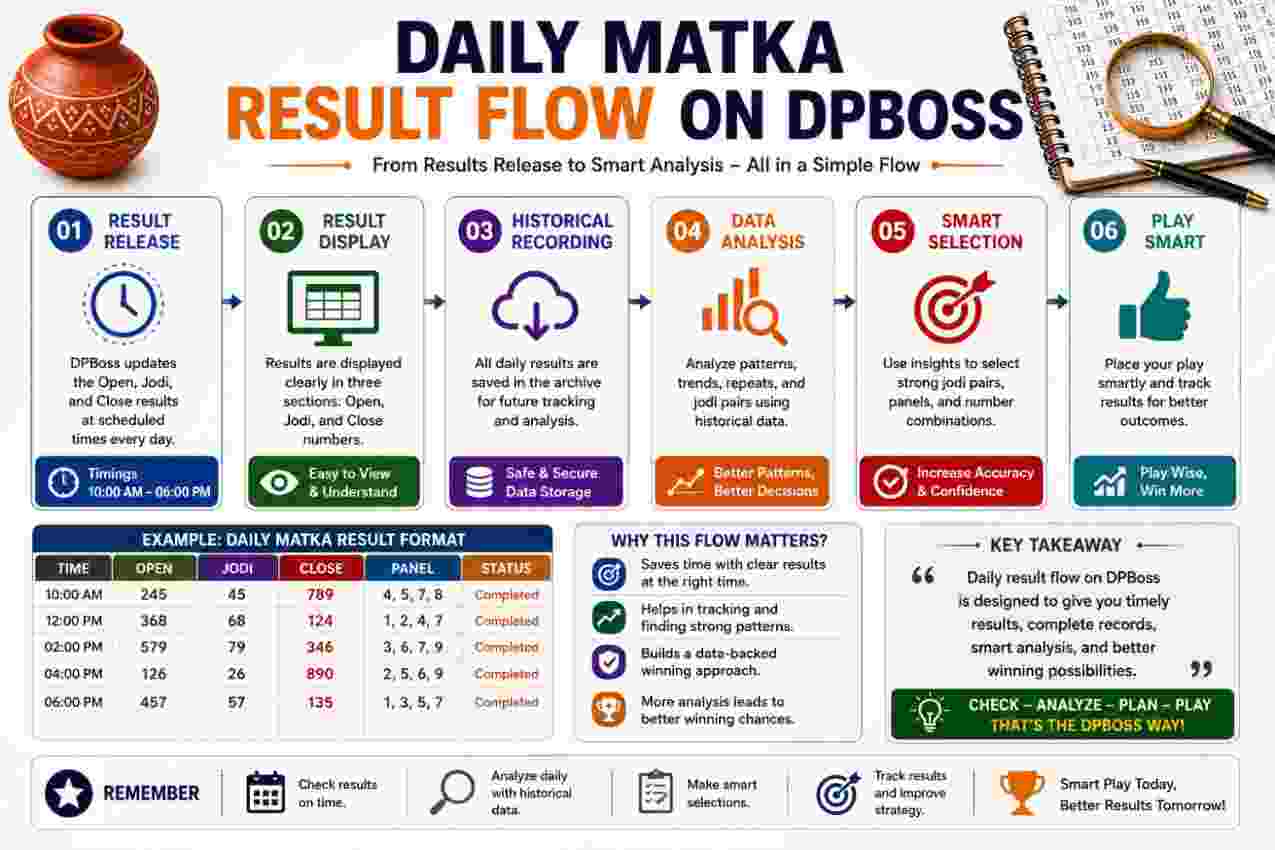
Matka players often follow several market sessions across a fixed daily schedule. Each session moves through opening declarations, panel updates, closing digits, verification, and recordkeeping. Consequently, knowing the daily result flow helps readers interpret updates without confusing incomplete information with final outcomes. Dpboss Matka result pages commonly arrange this information by market name and declared time. A structured approach makes each update easier to follow, reduces mistakes, and allows readers to distinguish scheduled entries, delayed declarations, corrected figures, and completed results.
What Does Daily Matka Result Flow Mean?
Daily Matka result flow refers to the sequence through which market information appears during a working day. It begins with a published schedule and continues through active sessions, opening values, closing values, final combinations, and historical recording.
Although market timings vary, the underlying structure usually remains consistent. First, a market becomes active according to its scheduled period. Next, the opening result appears. The closing stage follows later, completing the displayed combination. Finally, the finished result enters a chart or archive for later checking.
This flow creates an organized information cycle. Without it, readers could struggle to identify whether a displayed number represents an opening digit, a closing digit, a panel, or a complete result.
The Main Stages of the Flow
A typical daily sequence includes:
- Publication of active market names and timings
- Arrival of the opening panel
- Calculation or display of the opening digit
- Waiting period before the closing session
- Publication of the closing panel
- Display of the closing digit
- Completion of the final pair
- Verification and chart entry
Each stage carries a different meaning. Therefore, readers should avoid treating partial information as a completed outcome.
Why Sequence Matters
The same digit can appear in several markets during one day. However, market identity and declaration time separate one result from another. A clear sequence prevents readers from attaching a valid number to the wrong market.
Moreover, the sequence helps identify delayed updates. If an opening value appears while the closing field remains blank, the market has not completed its cycle. Consequently, users should wait for the final declaration before recording the full result.
How the Daily Schedule Organizes Results
A daily schedule provides the framework for every result update. It lists markets according to opening and closing times, enabling readers to track sessions in chronological order.
Dpboss Matka information commonly presents early, afternoon, evening, and late-night markets within one organized layout. Nevertheless, scheduled times may differ across days or market categories. Readers should always match the market name with its designated session instead of relying only on memory.
Early Sessions
Early sessions begin the daily flow. These markets usually receive attention first because their opening and closing declarations occur before the main afternoon activity.
A typical early-session process follows three steps:
- The market name appears as active.
- The opening panel and digit become available.
- The closing panel completes the final pair.
Once the closing value appears, the result moves from active status to completed status. Meanwhile, later markets remain scheduled or pending.
Afternoon Sessions
Afternoon sessions often create the busiest period because multiple markets may overlap. One market may await its closing declaration while another begins its opening stage.
Therefore, careful identification becomes essential. Readers should check:
- Exact market name
- Scheduled opening time
- Scheduled closing time
- Current result status
- Whether both panels appear
- Whether the final pair has formed
Additionally, users should refresh information carefully rather than assuming every blank field indicates an error. Sometimes a blank field simply means the relevant stage has not occurred.
Evening and Late-Night Sessions
Evening markets continue the same opening-and-closing pattern. However, late sessions may finish near midnight, which can create date confusion.
For example, a market listed under one date may complete late in the evening. Consequently, readers should associate the result with the schedule date shown for that market. The clock alone does not always provide enough context.
Late-night results also require patient verification. A premature entry can carry an incomplete pair into personal notes or historical comparisons.
How Opening Results Appear
The opening result starts the numerical part of a market session. It usually includes an opening panel and a single opening digit derived from that panel.
The panel commonly contains three digits. Their total determines the displayed single digit according to the accepted calculation method. If the three-digit total contains two digits, the final digit becomes the opening value.
Reading an Opening Panel
Suppose an opening panel shows 148. Adding the digits gives:
- 1 + 4 + 8 = 13
- The final digit of 13 is 3
- Therefore, the opening digit becomes 3
At this stage, the result remains incomplete because the closing panel has not appeared. The display may show the opening panel and opening digit while leaving the closing positions blank.
Recognizing an Incomplete Display
An incomplete result may appear in a format resembling:
148-3
This format communicates only the opening stage. It does not represent the finished market result.
Consequently, readers should avoid guessing the closing digit or treating an empty closing field as zero. A missing value simply indicates that the market session continues.
Why Opening Updates May Arrive Late
Opening updates can face delays because of schedule changes, verification requirements, communication issues, or technical problems. However, a delay does not automatically mean that the market has closed or been cancelled.
Users should check the displayed status and scheduled time. Moreover, they should avoid relying on unofficial screenshots or forwarded messages that lack a clear date and market name.
How Closing Results Complete the Session
The closing result finishes the daily cycle for a particular market. It includes a closing panel, its derived single digit, and the completed two-digit pair.
If the opening digit is 3 and the closing digit is 7, the final pair becomes 37. Therefore, the result display combines both stages into one readable sequence.
Reading a Completed Result
A completed display may look like:
148-37-269
In this example:
- 148 represents the opening panel.
- 3 represents the opening digit.
- 7 represents the closing digit.
- 269 represents the closing panel.
- 37 represents the completed pair.
This structured format allows readers to review every component without performing separate searches.
The Importance of the Final Pair
The final pair provides the quickest summary of a completed session. Nevertheless, the panels remain useful because they show how every single digit formed.
Some readers record only the pair, while others preserve the full panel sequence. For accurate historical tracking, the complete entry offers stronger context. Additionally, a complete record helps identify transcription mistakes when figures look inconsistent.
Closing Delays and Pending Status
A market may show an opening result for a long period before publishing the closing value. During that interval, the session remains pending.
Therefore, users should not fill the gap with assumptions. They should wait until the complete entry appears and then compare all displayed components. If the pair conflicts with either panel calculation, further verification may be necessary.
Result Statuses Readers May Encounter
Not every market row displays a completed result. Status labels, blank spaces, partial numbers, and correction markers communicate different stages of the daily flow.
Recognizing these signals prevents unnecessary confusion and incorrect recordkeeping.
Scheduled
A scheduled market has not reached its active declaration period. Its row may display timing information without any result figures.
Open Declared
This status means the opening panel and digit have appeared, but the closing stage remains pending. The displayed information represents only part of the final sequence.
Closed or Final
A closed result contains both panels, both single digits, and the completed pair. Readers can then record it as the final entry for that session.
Delayed
A delayed status indicates that the expected declaration has not arrived at the usual time. Consequently, users should wait for an authenticated update rather than using information circulated elsewhere.
Corrected
Occasionally, a published figure may require correction. A corrected result replaces the earlier display after verification. Readers who maintain personal records should update the entire entry, including panels and the final pair.
Cancelled or Unavailable
A cancelled session produces no valid result. Similarly, an unavailable field may indicate missing information rather than a completed zero value. The displayed notice should determine how readers treat that session.
How to Read a Dpboss Matka Result Page
A well-organized result page usually places the market name, schedule, opening panel, pair, and closing panel in separate but connected areas. Readers can scan the information quickly once they recognize the layout.
However, rapid scanning sometimes causes errors. A disciplined reading order offers better accuracy.
Start With the Market Name
Always identify the market before reading its numbers. Several rows may display similar-looking combinations, particularly during busy afternoon and evening periods.
Next, confirm the date. This step matters when users check late-night updates or return to an open page from an earlier session.
Check the Session Timing
The schedule indicates whether a market should appear as upcoming, active, or completed. If the closing time has not passed, an incomplete result may be entirely normal.
Meanwhile, a blank result after the expected closing time may signal a delay. Readers should allow time for verification before recording anything.
Read From Left to Right
A consistent reading pattern reduces mistakes:
- Opening panel
- Opening digit
- Closing digit
- Closing panel
- Final pair confirmation
Some layouts place the pair between the panels. Therefore, users should inspect the column headings before interpreting the figures.
Confirm the Panel Calculations
Adding the three digits in each panel provides a simple accuracy check. The final digit of each total should match the corresponding open or close value.
If the figures do not align, users should pause before recording the result. The display may contain a temporary error, or the reader may have attached one panel to the wrong row.
Why Results Sometimes Change After Publication
Fast updates can occasionally contain typographical, formatting, or transmission errors. As a result, a value may change shortly after its first appearance.
A correction does not necessarily affect every component. Sometimes only one panel changes; in other cases, the revised panel also changes the associated digit and final pair.
Common Causes of Corrections
Corrections may occur because of:
- Mistyped digits
- Reversed panel order
- Incorrect market placement
- Calculation mismatch
- Delayed official confirmation
- Display synchronization problems
- Cached page information
Therefore, users should recheck a result before adding it to a permanent record.
How to Handle Conflicting Figures
When two versions appear, compare the market name, date, declaration time, panels, and pair. A cropped image may omit essential context, while an old page may display a previous session.
Moreover, users should wait for a stable final display. Repeatedly switching between unverified versions increases the risk of carrying an incorrect figure into charts or notes.
Refresh Without Losing Context
Refreshing can reveal a corrected result, but it can also move the reader’s attention to another row. Before refreshing, note the precise market name and current status.
Afterward, locate the same row and confirm every field. This simple habit protects against accidental comparisons between neighbouring markets.
Daily Charts and Historical Records
Once a market completes its session, its result can enter a daily, weekly, monthly, or long-term chart. These records organize past outcomes by date and market.
Charts provide historical context, but they do not alter the daily flow. The live sequence still begins with scheduling and ends with a verified closing declaration.
What a Daily Chart Contains
A daily chart may include:
- Market name
- Calendar date
- Opening panel
- Opening digit
- Closing digit
- Closing panel
- Final pair
- Closed or unavailable status
Some charts show only the final pair. In contrast, detailed charts preserve the full result structure.
Why Accurate Dates Matter
A correctly recorded number can still create confusion when attached to the wrong date. Late-night markets, schedule changes, and archived pages increase this risk.
Consequently, every saved entry should include the market name and date. Adding the full panel sequence provides another layer of verification.
Live Results Versus Archived Results
Live sections prioritize current declarations and pending stages. Archived charts prioritize completed historical entries.
Therefore, users should check live information for an active session and use charts for earlier dates. Mixing these purposes can make an unfinished market appear missing from an archive.
Common Mistakes While Following Results
Most reading errors occur because users move too quickly, overlook context, or treat incomplete information as final.
Fortunately, a consistent checking routine prevents many of these problems.
Confusing Similar Market Names
Some market names look alike or share related labels. Nevertheless, they may operate at different times and produce separate results.
Always read the full name rather than relying on the first word or a familiar colour, position, or abbreviation.
Treating the Opening Digit as the Final Pair
An opening digit represents only half of the pair. Until the closing digit appears, the complete result remains unknown.
Therefore, record opening values separately if monitoring an active session.
Ignoring the Date
An open browser tab may retain an earlier date. Similarly, a saved screenshot may circulate after its result has become outdated.
Checking the date before reading the numbers prevents this mistake.
Reading Adjacent Rows
Dense layouts can make neighbouring rows appear connected. Users should trace horizontally across one row and confirm its market label before noting any figures.
Depending on Unverified Messages
Forwarded messages may contain cropped, mistyped, or outdated information. Moreover, they may omit correction notices.
A complete result display with visible market and date information offers stronger clarity than an isolated number.
A Reliable Result-Checking Routine
A simple routine makes Dpboss Matka result tracking more orderly. It also reduces repeated checking and careless transcription.
Follow these steps for each market:
- Confirm the correct calendar date.
- Locate the full market name.
- Review its scheduled opening and closing times.
- Identify whether the result remains scheduled, open, delayed, or final.
- Read the opening panel and calculate its digit.
- Wait for the closing declaration when necessary.
- Calculate the closing digit from its panel.
- Confirm that both digits form the displayed pair.
- Recheck the row after a short interval.
- Record the complete result only after confirmation.
Maintain Clear Personal Records
If users keep notes, they should use a consistent format. For example:
Date | Market | Open Panel | Pair | Close Panel | Status
This format separates each field and supports quick checking. Additionally, status notes help identify cancelled, delayed, or corrected sessions.
Review Before Closing the Record
At the end of a session, compare the saved entry with the final displayed row. Check each digit individually instead of relying on visual familiarity.
Consequently, even a small reversal, such as 37 becoming 73, becomes easier to detect.
Responsible Use of Result Information
Matka involves financial risk and uncertain outcomes.Recordss cannot guarantee future figures, and repeated patterns do not create certainty.
Therefore, readers should treat result pages as information displays rather than promises of profit. No chart, panel sequence, or previous pair can remove randomness from a future session.
Set Firm Financial Limits
Anyone who chooses to participate should use only an amount they can afford to lose. Borrowed money, essential household funds, and emergency savings should remain completely separate.
Moreover, chasing losses can increase financial harm. A fixed limit and a clear stopping point provide essential protection.
Follow Local Laws
Rules concerning gambling and number-based betting vary by jurisdiction. Consequently, readers should check applicable laws before participating.
Access to result information does not automatically make related activity lawful.
Protect Personal Information
Users should never share passwords, banking credentials, one-time codes, identity documents, or sensitive payment details with unknown individuals.
Additionally, claims of guaranteed numbers, fixed outcomes, or certain profits should raise immediate concern.
Conclusion
The daily result flow follows a clear path from scheduling to opening declaration, closing confirmation, final pairing, and historical recording. Readers can avoid common mistakes by checking the market name, date, session status, panels, and calculated digits before saving any entry. Additionally, patience helps when delays or corrections occur.
Dpboss Matka results become easier to interpret when users distinguish partial updates from completed sessions, maintain organized records, follow applicable laws, protect personal information, and recognise that previous figures cannot guarantee future outcomes.
FAQs
What does the daily Matka result flow include?
The flow includes the market schedule, opening panel, opening digit, closing panel, closing digit, final pair, verification, and chart entry. Each stage appears at a different point in the session. Therefore, readers must confirm that both opening and closing values appear before treating a result as complete.
How can readers identify a completed result?
A completed result usually displays the opening panel, two-digit pair, and closing panel. Both panels should calculate correctly to their respective single digits. Moreover, the market name, date, and status should match the intended session. A missing closing value means the result remains incomplete.
Why does a result remain blank after its scheduled time?
A blank field may indicate a delayed declaration, verification process, technical issue, schedule adjustment, cancellation, or temporary display problem. Readers should not interpret the blank as zero. Instead, they should confirm the market status and wait for a final update before saving the result.
Can a published Matka result receive a correction?
Yes. Typographical mistakes, reversed digits, calculation mismatches, or delayed confirmation can require correction. When a value changes, readers should verify the complete row again because a revised panel may also change its single digit and final pair. Permanent records should contain only the confirmed version.
Do historical charts predict future results?
No. Historical charts organize earlier results by market and date, but they cannot guarantee future outcomes. Apparent sequences or repeated digits may occur without creating a dependable prediction. Consequently, readers should avoid treating chart patterns, panel movements, or previous pairs as evidence of a certain future result.